How to Make Resin Bookmarks: A Beginner’s Guide
Resin Affairs is reader-supported. If you buy through links on this page, we may earn a small commission at no extra cost to you. We only link to gear we would use ourselves — prices and availability change, so check the current listing. Always follow your resin product’s label and Safety Data Sheet.
As an Amazon Associate I earn from qualifying purchases.
If resin crafting has a perfect first project, it might be the bookmark. Think about it: a bookmark uses barely an ounce of resin, needs no hardware or power tools, cures flat and fast, and still teaches you every core skill — measuring, mixing, placing embeds, popping bubbles, and demolding. Made one of our resin keychains? Bookmarks are the natural next step: same techniques, even smaller commitment, and arguably prettier results.
They’re also gift-giving gold. A pressed-flower bookmark in a birthday card, a birth-month-flower set for Mother’s Day, a glitter-ombre bookmark as a book-club favor — these are the projects people actually keep and use, which is more than you can say for most beginner crafts. And because each bookmark is a tiny canvas, you can test five design ideas in a single pour session for less resin than one pair of coasters.
To make resin bookmarks: arrange pressed flowers or glitter face-down in a rectangular silicone bookmark mold, mix a small batch of epoxy resin (or use UV resin for a fast-cure version), pour a thin even layer about 1/8 inch (2–3 mm) deep, pop bubbles with a toothpick or heat gun, and cure — overnight for epoxy, about 2–4 minutes per thin layer under a UV lamp for UV resin. Demold, lightly sand any rough edges, and thread a tassel or ribbon through the hole. Total hands-on time: about 20 minutes plus curing.
Supplies You’ll Need
One of the joys of bookmarks is the short shopping list. Here’s everything, with honest notes on what matters and what’s optional.
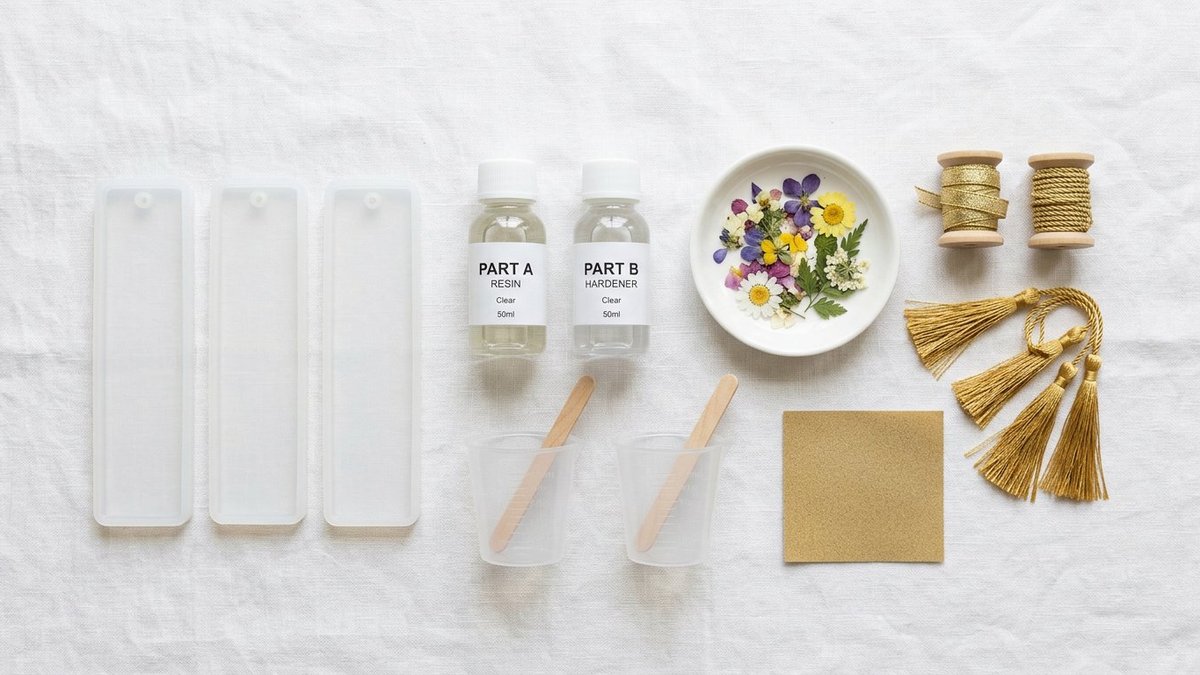
Resin — epoxy or UV, your choice. For a thin flat pour like a bookmark, standard epoxy resin (1:1 ratio kits are the most beginner-friendly) is the usual pick: crystal-clear, hard-wearing, and you can pour a whole batch of bookmarks from one small mix. Our mixing guide covers the two-cup method you’ll use. Prefer instant gratification? UV resin cures in minutes under a lamp with zero mixing — ideal if you only want to make one or two bookmarks and hate measuring. The trade-offs (lower heat resistance, lamp required, best for thin clear designs) are covered in our UV resin beginner guide. The short version: epoxy for gifts and batches, UV for fast single-piece experiments.
Rectangular bookmark silicone molds. Buy molds made specifically for bookmarks — they’re sized right (typically ~5.5–6″ long), release cleanly, and many come with a pre-molded tassel hole, which saves you drilling later. Sets that include tassels are great value for a first project. Our best resin molds for beginners guide explains what to look for in silicone quality (shiny interior = shiny bookmark; cloudy or matte interior = matte finish you’ll need to polish or dome).
Embeds — the fun part. Pressed flowers and leaves (fully dried — fresh plant material rots and browns inside resin), fine glitter, gold or silver foil flakes, mica powder for shimmer, tiny dried baby’s breath, and small flat charms or initial stickers for monogram designs. Start with a pressed-flower assortment + one glitter: that combination alone makes a dozen distinct bookmarks.
Tassel cord or ribbon. Most bookmark mold sets include basic tassels. To level up, buy satin ribbon, suede cord, or metallic tassels separately — the tassel is the first thing people touch, and a nice one makes a $1 bookmark feel like a $12 gift.
Mixing and finishing basics. Small graduated mixing cups (1 oz / 30 mL size is perfect — bookmarks sip resin), wooden stir sticks or silicone stirrers, toothpicks for bubble-popping and nudging petals into place, tweezers for placing pressed flowers (fingers crush petals and leave oils), and fine sandpaper (400–1000 grit) for smoothing edges after demolding. Nitrile gloves always — resin is a skin sensitizer, and “it’s just a tiny pour” is exactly when people skip protection.
Nice to have, not required: a heat gun or small butane torch for bubbles, a silicone mat to protect your table, and a dust cover (a cardboard box works) for the overnight epoxy cure.
🧰 Recommended Kit
- Caffox Bookmark Mold Kit (10 Silicone Molds + 100 Tassels) — 10 rectangle bookmark molds in two sizes, each with a pre-molded tassel hole, plus 100 tassels in 25 colors.
- LET’S RESIN 16oz Epoxy Resin Kit & Molds Complete Set — 16 oz of 1:1 epoxy with four silicone molds, glitter, dried flowers, cups and gloves in the box. The molds are spheres and pyramids, so add the bookmark molds above.
- Dried Flowers for Resin, 106pcs Natural Flowers and Leaves — real pressed flowers and leaves (not printed), 37 styles in six packs, small enough for a bookmark, with tweezers included.
- 45-Piece Wet/Dry Sandpaper Assortment (400–3000 Grit) — covers the 400 to 1000 grits used to smooth the edges after demolding.
📋 Get the Free Resin Safety & Prep Checklist
A one-page printable checklist covering PPE, ventilation, and workspace setup — so you’re not hunting through this guide mid-pour. Enter your email and we’ll send it straight over.
Free. We only email when there’s something useful, never more than twice a month, and you can unsubscribe anytime. Privacy Policy
Step-by-Step: Making a Resin Bookmark
Here’s the full process, start to finish. Hands-on time is about 20 minutes; the rest is curing. Read through once before you mix anything — resin waits for no one.
Step 1 — Prep your mold and workspace
Set your silicone mold on a level surface (check with your phone’s level app — resin self-levels, which means it faithfully reproduces any tilt). Make sure the mold interior is clean and dust-free; a strip of packing tape dabbed inside lifts lint better than rinsing. Lay out flowers, glitter, tweezers, and toothpicks before mixing. Put on nitrile gloves and safety glasses and set up ventilation per our resin safety hub — small pour, same chemistry, same protection.
Step 2 — Mix a small batch of resin
Bookmarks use very little resin — roughly ½–1 oz (15–30 mL) per bookmark depending on mold size. Mix only what you need plus a splash extra. Follow the two-cup mixing method: measure Parts A and B exactly per your kit’s ratio, stir slowly for 3–5 minutes scraping sides and bottom, transfer to a clean second cup, and stir 2 minutes more. Rushing this step is the #1 cause of sticky bookmarks — unmixed streaks never harden. UV resin shortcut: no mixing at all — you’ll pour straight from the bottle in Step 4 and cure under the lamp in Step 6.
Step 3 — Arrange embeds face-down in the mold (the step that matters most)
Here’s the trick most beginners get backwards: place pressed flowers and flat embeds face-down against the bottom of the mold — because the bottom of the mold becomes the top face of your finished bookmark. Anything you lay facing up will end up on the back.
Using tweezers, arrange petals and leaves on the dry mold floor first, composing your design like a tiny collage. Pressed flowers should sit as flat as possible — overlapping petals trap air, so keep layers minimal. For glitter or mica, you have two options: sprinkle dry into the mold for concentrated sparkle zones, or stir it into the resin for even suspension. For foil flakes, tweezers + dry placement gives the most control.
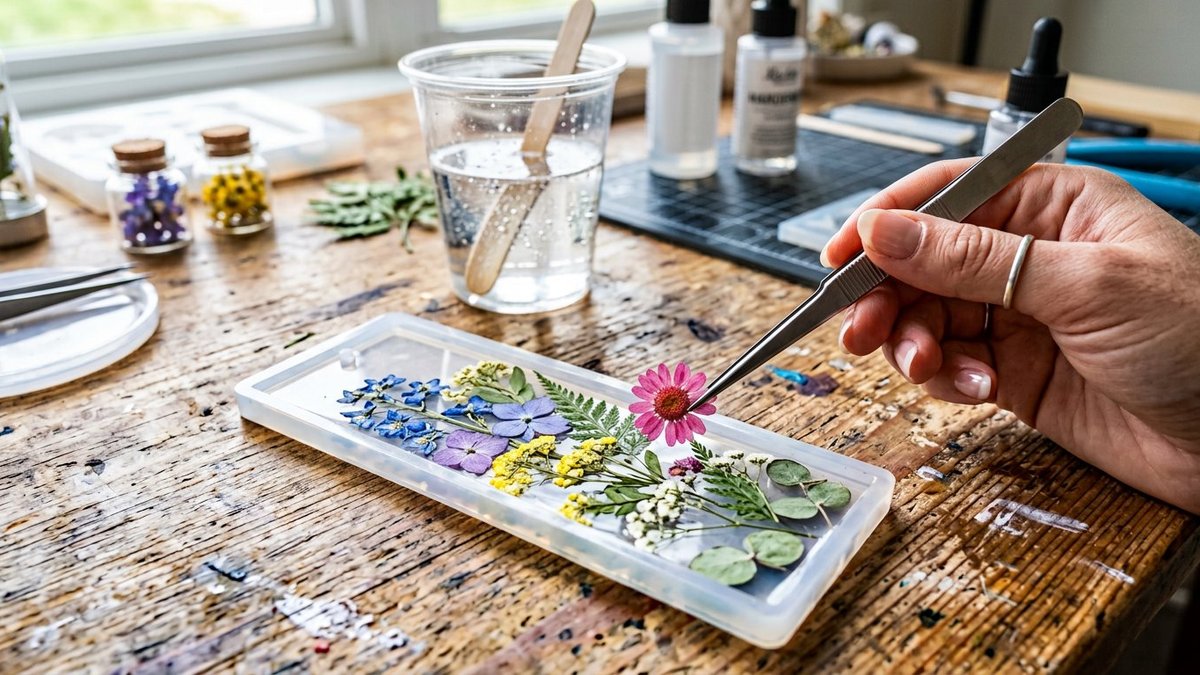
Take a phone photo of your dry layout before pouring — once resin goes in, petals drift, and the photo helps you nudge things back with a toothpick.
Step 4 — Pour a thin, even layer
Pour resin slowly from one end of the mold, letting it flow across the design rather than dumping it on top (a hard pour displaces petals and whips in bubbles). Aim for 1/8 inch (2–3 mm) deep — enough to fully cover embeds with a hair of clearance. Bookmarks thicker than ~5/32 inch (4 mm) feel clunky in a book and are more prone to edge chips; thinner than ~1/16 inch (1.5 mm) risks warping during cure. Fill just to the mold’s inner rim, not above it — overfilled bookmarks demold with a ragged lip that needs heavy sanding.
Step 5 — Pop bubbles and adjust
Give the mold 2–3 minutes for bubbles to rise, then pop surface bubbles with a toothpick, or a quick pass of a heat gun on low (keep it moving, 6–8 inches away — lingering heat warps thin pours). Never use a lighter. Use the toothpick to nudge any drifted petals back into position, referencing your layout photo. Then stop touching it — every poke after the first 10 minutes risks new bubbles and fingerprints in gelling resin. Cover epoxy pours with a dust cover (box or tray propped above, not touching).
Step 6 — Cure (branch: epoxy vs. UV)
- Epoxy: leave undisturbed 12–24 hours at 70–80°F (21–27°C), then demold. It’s usable after about 72 hours and reaches full hardness in about 7 days — the bookmark may feel slightly flexible at demold; that’s normal. Don’t force-flex it.
- UV resin: UV resin cures best in layers of about 1/16 inch (1.5 mm), so pour a 1/8-inch bookmark in two thin layers and cure each one. Place it under a 36W+ UV lamp (365–405 nm) for 2–4 minutes per side, flipping once. Thin clear designs cure fastest; opaque pigments and deep glitter slow curing — when in doubt, add a minute. Sunlight works in a pinch but is slower and less even.
Step 7 — Demold carefully
Peel the silicone mold back from the bookmark rather than pushing the bookmark out — flex the mold, not the casting. Fresh epoxy is fully firm but not yet full-strength; handle by the edges. If a bookmark resists, the mold may be under-cured (cold room?) — give it a few more hours rather than forcing it.
Step 8 — Sand rough edges
Even a perfect pour usually leaves a faint mold seam or a sharp edge. Wet-sand edges lightly with 400 grit to remove the seam, then 800 → 1000 to smooth. Keep the flat faces untouched — sanding the faces clouds the gloss (if you scuff a face, a thin doming coat of resin restores clarity). Rinse and dry.
Step 9 — Thread the tassel
If your mold has a pre-molded hole, simply loop the tassel cord or ribbon through and knot. No hole? Drill a small (1.5–2 mm) hole ¼″ from the top with a pin vise or small rotary tool at low speed — cured epoxy drills cleanly if you go slow and don’t press hard. A tiny drop of clear glue on the knot keeps tassels secure through years of page-turning.
That’s it — you’ve made a resin bookmark. Now make ten more, because the first one never survives gift-giving season.
Design Ideas for Resin Bookmarks
Six designs, ordered from easiest to most giftable. Each one uses the same pour technique above; only the embeds change.
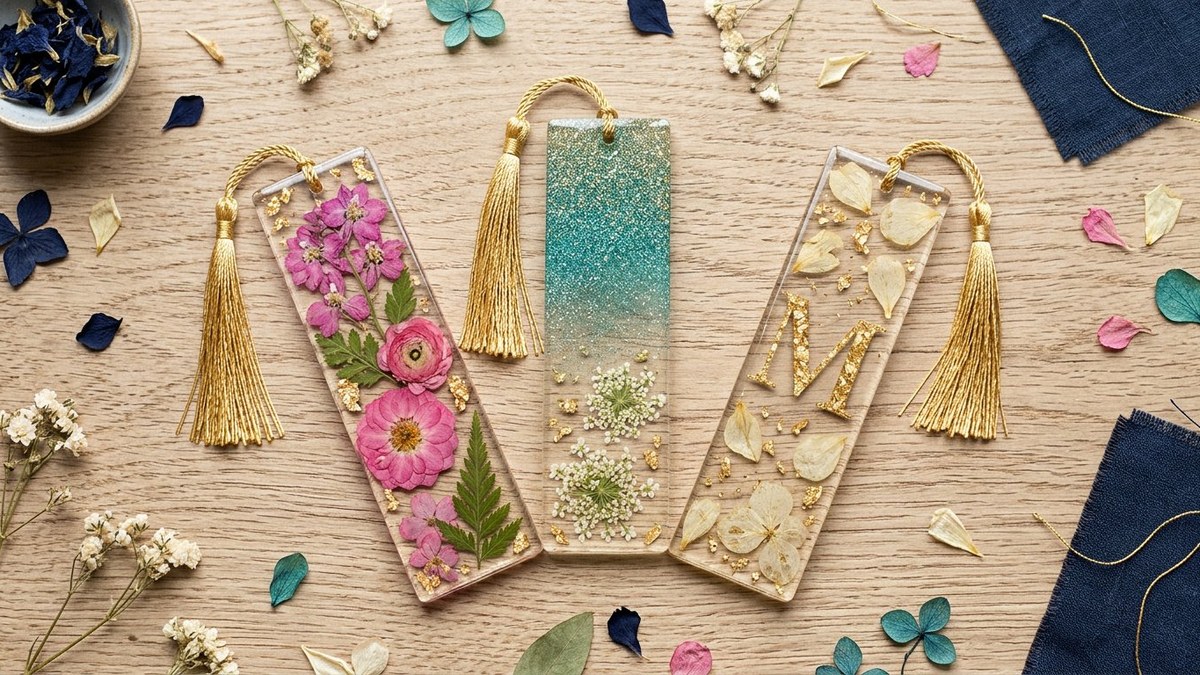
- Pressed real-flower bookmarks (the classic). Small blooms — baby’s breath, tiny daisies, violas, fern fronds — arranged face-down in a vertical composition. Design tip: odd numbers of blooms (3 or 5) look more natural than even rows, and a single trailing fern along one edge adds movement. Fully dried flowers only; press fresh ones 2–3 weeks or buy a pressed assortment. Clear resin, no tint — let the petals be the color.
- Birth-month-flower bookmarks (the gift). Same technique as above, but each bookmark features one birth-month bloom — carnation for January, violet for February, daffodil for March, and so on. Make a set of twelve for a spectacular gift, or singles for birthday cards. Add a tiny gold initial sticker of the recipient for a personal touch.
- Glitter ombre bookmarks (the crowd-pleaser). Mix fine glitter into half your resin cup and leave the other half clear. Pour clear first, then glitter resin at one end, and drag a toothpick through the boundary 2–3 times for a soft gradient. Teal-to-gold and navy-to-silver work well together; chunky glitter sinks, so stick to fine or extra-fine grades. This design hides minor bubbles beautifully — great for absolute beginners.
- Personalized initial / monogram bookmarks (the seller). Place a gold vinyl initial, small alphabet sticker, or hand-stamped charm face-down in clear resin with a scattering of foil flakes. If you sell at markets, offer on-the-spot initial choice from a sticker sheet — a personal initial costs pennies and makes each bookmark feel made to order. Keep the letter ½″–¾″ tall so it reads at arm’s length.
- Color-block bookmarks (the modern one). Pour two colors in sequence: fill half the mold with tinted resin (navy, forest, or terracotta alcohol ink or resin dye), let it gel to a soft tack (60–90 minutes for most epoxies), then pour clear or gold-flake resin for the second half. The gelled boundary gives a crisp line; pouring both wet gives a soft blend — both look intentional, so you can’t really fail. Metallic mica powders make the most striking blocks.
- Pressed-leaf nature bookmarks (the autumn hit). Small skeleton leaves, ferns, eucalyptus sprigs, or maple-leaf tips in clear resin with a whisper of gold flake. Gather and press leaves in autumn (florals in spring) so they are completely dry before you pour. A kraft-paper sleeve + twine turns this 20-minute craft into a genuinely premium-feeling gift.
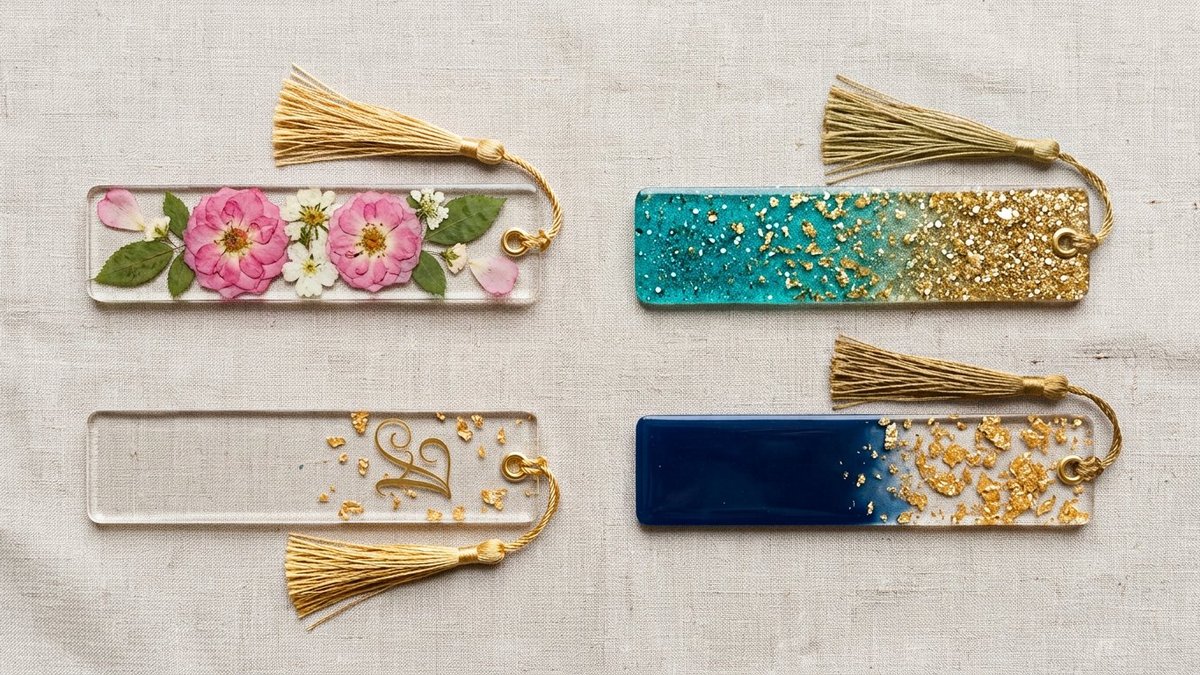
💡 BEGINNER TIP: Make your first batch a “sampler flight” — four bookmarks, four designs, one resin mix. You’ll learn which style you enjoy and end up with instant gifts.
Troubleshooting
Bookmarks are forgiving, but three issues come up often. For each, here’s the one-line fix plus a deep link — the full diagnosis lives in our common resin problems guide so this post stays focused.
- Sticky or soft spots after 24 hours → under-mixing. Unmixed streaks never cure. Prevention (the two-cup method + full stir times) beats any cure — see the mixing guide. If it’s already sticky, the problems guide covers when to wait, when to flood-coat, and when to start over.
- Bubbles trapped around petals → dry flowers off-gassing + poured too fast. Press flowers thoroughly dry, pour slowly from one end, and pop bubbles at 3 and 10 minutes. The problems guide’s bubble section covers heat-gun technique for thin pours.
- Warped or bendy bookmark → poured too thin or demolded too early. Stay in the 1/8 inch (2–3 mm) zone, cure at 70°F+, and wait the full 24 hours (epoxy keeps hardening for about 7 days). A slightly flexy fresh demold usually stiffens on its own within a day — don’t try to “fix” it by flexing.
Cloudy finish, dust nibs, or flower browning? All covered in the problems guide — bookmark the page (pun intended) before your first pour.
Frequently Asked Questions
What resin is best for bookmarks?
Standard 1:1 epoxy resin is the best all-round choice — clear, hard-wearing, and forgiving for beginners pouring thin flat layers. UV resin is a great fast-cure alternative for one-off bookmarks (no mixing, cures in minutes under a lamp) but needs a UV lamp and suits thin, mostly-clear designs best.
How thin should a resin bookmark be?
Aim for 1/8 inch (2–3 mm) thick — sturdy enough to handle daily page-turning without feeling clunky in a book. Under ~1/16 inch (1.5 mm) risks warping during cure; over ~5/32 inch (4 mm) feels bulky and chips more easily at the edges. Fill your mold just to its inner rim for the right depth automatically.
Can I use dried or pressed flowers in resin bookmarks?
Yes — fully dried or pressed flowers work beautifully. The key word is fully: fresh or damp plant material rots, browns, and releases bubbles inside cured resin. Press fresh flowers 2–3 weeks between book pages, or buy a pressed-flower assortment with small blooms sized for a 1″-wide bookmark.
How long does a resin bookmark take to cure?
Epoxy bookmarks need 12–24 hours before demolding, about 72 hours before use and about 7 days for full hardness. UV resin bookmarks cure in 2–4 minutes per side under a UV lamp. Hands-on time is the same either way — about 20 minutes of arranging, pouring, and bubble-popping.
Do resin bookmarks need to be sealed after curing?
No — cured epoxy is already hard, clear, and moisture-resistant, so no sealant is needed. The only post-cure step is light edge sanding (400–1000 grit) to remove the mold seam. If sanding clouds a flat face, brush on a thin doming coat of resin to restore glass clarity.
Can I make resin bookmarks without a mold?
Yes, with caveats. The easiest mold-free method is coating pre-cut shapes (wood, acrylic blanks, or heavy cardstock sealed first with Mod Podge so resin can’t soak in) with a thin layer of resin. Free-pouring bookmark shapes without any mold is not recommended — resin self-levels into puddles, not rectangles. An inexpensive silicone mold set pays for itself in one session.
Sources
- WEST SYSTEM, Health Effects from Overexposure to Epoxy: you can become sensitized to epoxy after many exposures or just one, which is why gloves stay on even for a pour this small.
- NIOSH (CDC), Epoxies and resins: wear the right gloves, increase ventilation, and wash skin as soon as possible after contact.
- OSHA, Hazard Communication: your kit’s label and Safety Data Sheet carry the mixing ratio and cure details for that product.
- University of Missouri Extension, Drying Flowers and Foliage for Arrangements (G6540): how to press flowers between sheets of nonglossy paper, changing the paper after the first week, and why flowers dried too hot turn brown.
- Let’s Resin help center, Know More About UV Resin: a UV lamp for resin should be in the 365–405 nm range, and too much pigment, glitter or mica stops the light getting through.
Keep Learning on ResinAffairs.com
- 🎁 Resin Gift Ideas for Beginners → — where bookmarks shine brightest: gifts people actually keep
- 🔑 How to Make Resin Keychains → — the sister project: same skills plus hardware and drilling
- 🧱 Best Resin Molds for Beginners → — silicone quality, mold care, and what shapes to buy first
- 🔧 Common Resin Problems and How to Fix Them → — sticky, bubbly, cloudy, or warped? Diagnose it here
- 🥣 How to Mix Epoxy Resin → — the two-cup method every bookmark pour depends on
- 🌸 How to Preserve Flowers in Resin → — how to dry flowers fully before they go into resin
Enjoyed this guide? Join the Resin Affairs newsletter for new tutorials, safety tips, and project ideas straight to your inbox.