
A pregnant woman in an apron stands at a sunlit wooden workbench, looking thoughtfully at a respirator mask, a bottle of clear liquid, and blue protective gloves.

Can You Use Epoxy Resin While Pregnant? Safety, Risks & Safer Alternatives

⚕️ Medically-Informed Content Notice

This article was researched using guidance from OSHA, NIOSH, the EPA, the American College of Obstetricians and Gynecologists (ACOG), and peer-reviewed studies on bisphenol and epoxy chemical exposure. It is written for educational purposes only and is not a substitute for personalized medical advice. Always consult your OB-GYN, midwife, or healthcare provider before making decisions about chemical exposure during pregnancy.

Written by: The ResinAffairs Editorial Team — practicing resin artists with 5+ years of hands-on experience and a deep focus on craft chemical safety.
Last reviewed: April 2026 | Next scheduled review: October 2026

A pregnant woman in an apron stands at a sunlit wooden workbench, looking thoughtfully at a respirator mask, a bottle of clear liquid, and blue protective gloves.

Introduction

If you just found out you’re pregnant (congratulations!) and your first panicked thought was, “Wait… can I even use epoxy resin while pregnant? I poured a tray last weekend — is my baby okay?” — take a breath. You’re not the first crafter to Google this at 2 a.m., and you won’t be the last.

Here’s the honest truth most blogs dance around: the safest choice is to avoid working with epoxy resin while you’re pregnant. That’s the short answer. But real life is messier than a one-liner.

Maybe resin is your full-time job. Maybe you have a commissioned piece due next week. Maybe you already poured three trays before you saw those two pink lines. Maybe you’re just not ready to put your favorite hobby on a 9-month pause without understanding why.

This guide is written for all of those situations.

We’re going to walk through what the research actually says about epoxy and pregnancy, which chemicals are the real troublemakers, and how to talk to your doctor about it (yes, you should — and yes, bring paperwork). If you absolutely must keep working with resin, we’ll cover the strict safety protocol that serious chemical-handling guidelines recommend.

And if you’re ready to press pause, we’ll show you safer crafting alternatives so you can keep your creative brain happy until baby arrives.

No scare tactics. No judgment. Just clear, practical information from one crafter to another.

 TL;DR – The 30-Second Answer

  • The safest choice is to avoid epoxy resin while pregnant. Most occupational and medical safety guidance recommends eliminating exposure when possible.
  • There is no established “safe” exposure level for epoxy components during pregnancy. (NIOSH Reproductive Health Hazards)
  • “Low odor” and “non-toxic” labels do not mean pregnancy-safe — they refer to cured products under normal use.
  • If you must work with resin (e.g., for your job): use a respirator with organic vapor cartridges, work in real cross-ventilation, wear nitrile gloves, and delegate mixing/sanding to someone else.
  • Already exposed before you knew? Don’t panic. Document what you remember and bring it to your next prenatal appointment.
  • Bring your resin’s Safety Data Sheet (SDS) to your doctor — it’s the only way they can give you specific advice.
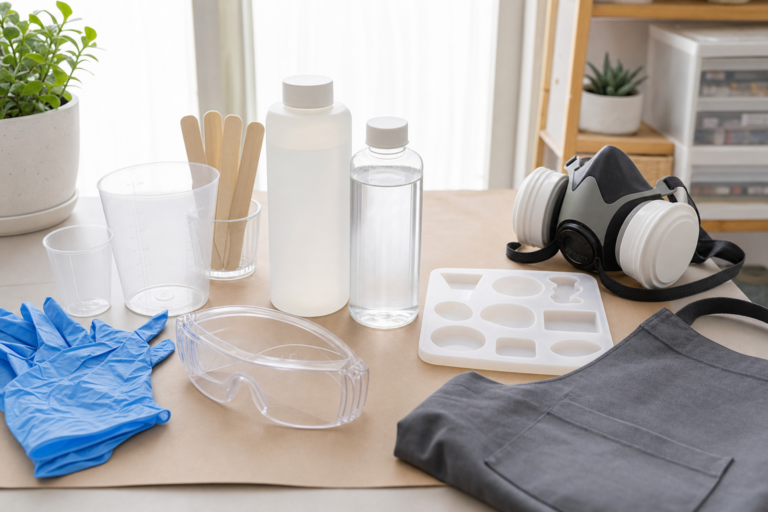
Proper PPE for resin crafting: A respirator with organic vapor cartridges, nitrile gloves, and a planning notebook organized on a wooden workbench.

A quick but important note: This article is for educational purposes only and is not medical advice. Every pregnancy is different, and your OB-GYN or midwife is the only person who can give you personalized guidance. When in doubt, call them. They’ve heard weirder questions, I promise.


Materials Needed (If You’re Continuing to Work With Resin)

If you and your doctor have decided that you can continue limited resin work, do not skip a single item on this list. These aren’t “nice to haves” — during pregnancy, they’re your baseline protection.

Respiratory Protection

  • A half-face respirator with organic vapor cartridges — This is non-negotiable. Dust masks, surgical masks, and even N95s do not filter the chemical fumes epoxy releases. You need cartridges specifically rated for organic vapors (look for the black band labeling on 3M-style cartridges).
  • Replacement cartridges — Cartridges expire faster than people think, especially once opened. Mark the date on them with a Sharpie and swap them out according to the manufacturer’s schedule.

Skin and Eye Protection

  • Nitrile gloves (not latex) — Latex can break down against resin chemicals and some people develop latex allergies during pregnancy. Nitrile holds up better and is hypoallergenic. Grab a box of thicker, 6-mil or 8-mil gloves rather than the thin food-prep kind.
  • Chemical splash goggles or safety glasses — Regular reading glasses don’t count. You want side coverage in case of splashes during mixing.
  • A dedicated apron, smock, or coveralls — Something you wear only for resin work and never toss in with the family laundry. Resin residue on fabric can transfer to other clothes and skin.
  • Long sleeves and closed-toe shoes — Skin coverage matters even with gloves on.

Ventilation and Workspace

  • Two box fans (minimum) — One to pull fresh air in, one to push fumes out. Creating airflow across your work area is the goal, not just blowing air around the room.
  • A dedicated workspace away from living areas — A garage, outdoor covered patio, or detached workshop is ideal. Never pour resin in a bedroom, kitchen, or nursery.
  • A silicone work mat — Cured resin peels right off, which means fewer cleanup chemicals and less scraping (which can release dust).

Cleanup and Safety Supplies

  • Plain soap and warm water — For skin contact. Do not use solvents like acetone or alcohol on your skin to clean off resin; they actually push chemicals deeper into your skin.
  • Paper towels and a dedicated trash bag — For contaminated items. Seal the bag before bringing it through living spaces.
  • Safety Data Sheets (SDS) for every resin and hardener you use — Print these out. You’ll need them for your doctor’s appointment, and they tell you exactly what chemicals you’re dealing with.

The “Extra Hands” Person

This isn’t a product you can buy, but it’s the most important item on the list: a non-pregnant helper who can do the highest-exposure tasks for you — mixing resin and hardener, large pours, and any sanding of cured pieces. If you don’t have someone available to help, that’s a strong sign this project should wait.

Quick Answer – Is It Safe to Use Epoxy Resin While Pregnant?

Short Answer: Most Experts Recommend Avoiding Epoxy During Pregnancy

Let’s not bury the lead: the safest choice is to avoid working with epoxy resin while you’re pregnant.

That’s not me being dramatic. That’s the consistent recommendation from occupational health experts, chemical safety guidelines, and most OB-GYNs when they’re asked directly. Uncured epoxy contains chemicals that have been linked to reproductive and developmental concerns, and the general advice is to eliminate or drastically reduce exposure during pregnancy.

Here’s the part that trips people up: there is no established “safe” level of epoxy exposure during pregnancy. Researchers haven’t identified a threshold below which exposure is considered harmless for a developing baby. When there’s no known safe dose, the default safety advice is always the same — avoid it if you can.

I know that’s not the fun answer. If resin is your hobby, your stress relief, or your income, hearing “just stop” feels huge. But your baby’s development, especially in the first trimester, happens fast and it happens once. Nine months is a short pause in the grand scheme of your crafting life.

Why “I Don’t Smell Anything” Doesn’t Mean “Safe”

This is one of the biggest misconceptions in the resin world, so let’s clear it up right now.

Just because a resin is labeled “low odor” or “non-toxic” does not mean it’s free of harmful chemicals. Those labels are marketing terms, not pregnancy safety certifications. Low-odor resins can still release VOCs (volatile organic compounds) — airborne chemicals you can inhale without ever smelling them.

Think of it like carbon monoxide. You can’t smell it, you can’t see it, and it can still hurt you. VOCs work the same way. Some of the most concerning chemicals in uncured resin have very weak odors or no odor at all at the concentrations that cause harm.

Your nose is not a chemical detector. If a product smells “fine” to you, that only tells you one thing: it smells fine. It doesn’t tell you anything about BPA content, hardener chemistry, or what’s off-gassing during the cure.

An extreme close-up of a blue epoxy resin bottle label. The words "EPOXY RESIN" are prominent at the top in white block letters. Below, two green checkmarks highlight "Low Odor" and "Non-Toxic Formula." At the bottom, a "CAUTION" section warns that the product may cause skin irritation or allergic reactions. The background is a softly blurred workshop setting with a mixing cup and stir stick.

The takeaway: trust the Safety Data Sheet, not the marketing copy on the front of the bottle. We’ll talk more about how to read an SDS in a later section.

Understanding Epoxy Resin and Why Pregnancy Changes the Risk

What Epoxy Resin Is (Uncured vs. Fully Cured)

If you’re newer to the craft, here’s the quick version: epoxy resin is a two-part system. You’ve got Part A (the resin) and Part B (the hardener). On their own, they’re just goopy liquids. Mix them in the right ratio and a chemical reaction called curing kicks off — the liquid slowly transforms into a hard, glassy solid.

That curing process is where things get chemically interesting (and where pregnancy risk lives).

Uncured epoxy — meaning freshly mixed or still curing — is the highest-risk stage. The chemicals are still reactive, still off-gassing, and still able to soak into skin or float into your lungs. This includes the moments when you’re measuring, stirring, pouring, and waiting for the piece to harden (usually 24–72 hours depending on the product).

Fully cured epoxy — a piece that has completely hardened and is no longer tacky — is much more stable. Once the chemical reaction is finished, the concerning components are mostly locked into the solid structure. A fully cured coaster sitting on your coffee table is not a major exposure risk.

But here’s the catch: “fully cured” only counts if it was mixed correctly, at the right ratio, in the right temperature. Badly mixed resin can stay sticky and continue off-gassing for weeks. And even cured resin can release dust and residual chemicals if you sand, cut, or drill it.

Key Chemicals in Epoxy Resins That Raise Pregnancy Concerns

Not all resins are made the same, but most traditional epoxy systems contain some combination of these troublemakers:

  • Bisphenol A (BPA) and similar compounds — BPA is the big one. It’s a known endocrine disruptor (meaning it can mess with your hormones) and has been classified as a reproductive and developmental toxicant in various safety frameworks. Even “BPA-free” epoxies often use close chemical cousins like BPF or BPS, which may carry similar risks.
  • Hardeners (amines) — The Part B side of your resin kit is usually made from amine-based chemicals. hardeners (amines)… are strong skin sensitizers (OSHA – Epoxy Resin Hazards) and can cause chemical burns, allergic reactions, and respiratory irritation.
  • Reactive diluents — These are added to thin out the resin so it’s easier to pour. Many of them are small, volatile molecules that evaporate easily — which means they end up in the air you’re breathing.
  • VOCs (volatile organic compounds) — Released during mixing and curing. You may or may not smell them. They can cause headaches, dizziness, and respiratory issues even in healthy adults.

Here’s where the pregnancy concern gets sharper. Some of these chemicals have been shown in animal studies to be embryotoxic (harmful to developing embryos) and teratogenic (capable of causing birth defects). In plain English: in lab animals, exposure to certain epoxy components has been linked to miscarriage, malformations, and developmental delays.

We’ll get into what that means for humans in the next section, but the short version is: this is why “better safe than sorry” isn’t overcautious advice — it’s the standard recommendation.

How Epoxy Enters the Body: Fumes vs. Skin Contact

There are two main doorways for epoxy chemicals to get into your bloodstream, and both matter during pregnancy.

1. Inhalation (breathing it in)

Every time you mix, pour, or wait for resin to cure, chemicals are releasing into the air. You breathe them in, they cross into your lungs, and from there they can enter your bloodstream. During pregnancy, your blood volume and breathing rate both increase — which means you’re actually inhaling more air (and more of whatever’s floating in it) than you did pre-pregnancy.

2. Skin absorption (soaking in through contact)

This one surprises people. Your skin is not a barrier — it’s a sponge. When uncured resin touches bare skin, even a tiny splash, some of those chemicals can absorb directly into your body. No fumes required.

A medical infographic titled "How Resin Exposure Reaches Your Body" explaining two pathways of absorption. On the left, under "Inhalation Pathway," a diagram shows resin vapor rising from an open container into a human silhouette

There’s a third issue worth flagging: epoxy is a skin sensitizer. That means the more you’re exposed, the more likely your body is to develop an allergic reaction to it — and once you’re sensitized, it’s usually permanent. A lot of professional resin artists have had to abandon the craft entirely after developing a severe reaction.

Pregnancy can make your skin and immune system more reactive than usual, which is why a pregnant crafter’s chances of developing a lifelong resin allergy are higher than the average hobbyist’s. That’s a risk worth thinking about beyond just the baby — it’s about protecting your future creative career too.

Potential Pregnancy Risks From Epoxy Resin Exposure

Before we dig in, one important framing note: the human research on epoxy and pregnancy is limited. You won’t find a giant clinical trial of pregnant people pouring resin — for obvious ethical reasons. Most of what we know comes from animal studies, occupational exposure data (workers in resin-heavy industries), and the chemistry of the individual ingredients.

That limited data is exactly why experts lean cautious. When you can’t prove something is safe, the responsible move is to assume it might not be.

Reproductive Health Risks Linked to Epoxy Chemicals

Studies and occupational health reports have associated exposure to epoxy components — especially BPA and similar bisphenols — with a range of reproductive concerns:

  • Fertility problems — Research on BPA exposure has linked it to hormonal disruption affecting ovulation, implantation, and fertility (Peretz et al., Environmental Health Perspectives, 2014).
  • Miscarriage and stillbirth — Some occupational studies have noted higher rates of pregnancy loss among workers regularly exposed to epoxy-related chemicals (NIOSH Occupational Reproductive Health)
  • Birth defects and developmental problems — Including neurological and behavioral effects that may not show up until years after birth.
  • Low birth weight and preterm delivery — Flagged in some studies of workers with chronic chemical exposure.

None of these are guarantees. Exposure doesn’t mean harm, and plenty of people have been around epoxy without any pregnancy issues. But the pattern in the data is consistent enough that major safety bodies recommend avoiding exposure when possible.

The honest way to read this: we don’t know exactly how much is too much, so any amount is a gamble.

Embryotoxic and Teratogenic Effects Seen in Animal Studies

Let’s translate the scary-sounding science words.

Embryotoxic means “harmful to a developing embryo. In animal studies, certain epoxy components have caused embryos to stop developing, fail to implant, or be lost in early pregnancy (NIH PubMed – Bisphenol A and Reproductive Toxicity). For a full review of how researchers test reproductive toxicity, see the EPA’s reproductive toxicity guidelines

Teratogenic means “causing birth defects.” Some of the same chemicals have been linked in animal research to visible malformations — things like skeletal abnormalities, organ development issues, and neural tube defects.

Now, animal studies don’t translate one-to-one to humans. A mouse at high lab doses isn’t the same as a person glancing at an open resin bottle. But animal data is one of the main tools we have for flagging potential human risk — and regulators take it seriously precisely because we can’t run the same experiments on pregnant humans.

Here’s the practical takeaway: when a chemical has shown reproductive harm in animals and we have no good data proving human safety, the default advice is to avoid it during pregnancy. That’s not paranoia. That’s just how every major medical safety framework works.

Risks to the Pregnant Parent: Allergies, Sensitization, and Irritation

This part often gets overlooked. People focus so hard on “is the baby safe?” that they forget your body is going through a lot too — and epoxy can make things harder on you directly.

Skin issues:

  • Red, itchy rashes and dermatitis (even from tiny splashes).
  • Chemical burns from stronger hardeners.
  • Full-blown allergic reactions that can escalate with each exposure.

Pregnancy often makes skin more sensitive and reactive than usual. Something that gave you a mild itch pre-pregnancy might give you a weeping rash now.

Respiratory issues:

  • Irritation in the throat, nose, and lungs.
  • Headaches, dizziness, and nausea (especially rough when you’re already dealing with morning sickness).
  • Triggering or worsening asthma.

The long-term career concern:

Here’s what’s worth repeating: once you develop a resin allergy, it’s usually permanent. Sensitization doesn’t “wear off” after baby arrives. Some crafters who pushed through resin work during pregnancy ended up permanently unable to touch epoxy again — meaning they lost their hobby or income source for good.

If resin is important to your future, protecting yourself from sensitization now is protecting your ability to keep crafting later.

A close-up shot of a person’s forearm showing a red, bumpy skin rash consistent with contact dermatitis or an allergic reaction. The arm is positioned over a cluttered craft workbench filled with resin mixing cups, brushes, and various bottles. The lighting is soft, emphasizing the texture of the skin irritation against the blurred workshop background.

Should You Pause Epoxy Projects While You’re Pregnant?

Okay, deep breath. This is the part where you have to make an actual decision — and only you (and your doctor) can make it. What I can do is give you the right questions to sit with.

Key Questions to Ask Before Continuing With Epoxy

Grab a coffee (decaf, I guess 😅) and honestly answer these:

1. Is this resin work a job or a hobby?

If it’s a hobby, the math is simple: a 9-month pause is nothing compared to a lifetime of crafting. If it’s your livelihood, the conversation gets more complicated — you may need to negotiate reduced duties, delegate pouring tasks, or take temporary leave. Either way, the answer shapes everything else.

2. Can these projects be postponed until after pregnancy and breastfeeding?

Be honest with yourself. Is that commission truly time-sensitive, or does it just feel urgent? Most clients will absolutely understand a pregnancy-related delay. “I’m pausing for medical reasons and will deliver in [month]” is a complete sentence.

3. Are there safer materials that can get you a similar result?

A lot of projects can be pivoted. Want to make jewelry? Try polymer clay or metal stamping. Want to paint a piece? Switch to water-based acrylics. We’ll cover specific alternatives in a later section — but the point is, “pause resin” doesn’t have to mean “pause creating.”

4. Do you have a truly well-ventilated, separate workspace?

Not “I crack a window in my craft room.” I mean a garage with the door open, a covered outdoor space, or a detached workshop. If your only option is a spare bedroom or kitchen table, the answer is already no — regardless of what the rest of this guide says.

What to Discuss With Your Doctor (Bring the SDS!)

Please, please do not rely on this article — or any article — as your final word. Talk to your OB-GYN or midwife. The American College of Obstetricians and Gynecologists (ACOG) recommends that pregnant patients discuss any chemical or occupational exposures with their provider.

Bring the Safety Data Sheet (SDS) for every resin and hardener you use.

The SDS is a free document every resin manufacturer is required to provide. You can usually download it straight from their website (search “[brand name] SDS”). It lists the exact chemicals in the product, their hazards, and handling precautions.

Why does this matter? Because “epoxy resin” is a category, not a single product. Your doctor needs to know what’s specifically in your bottle. Without the SDS, they’re guessing — and most doctors aren’t resin chemistry experts.

When you sit down with your provider, cover:

  • Your personal health history — existing allergies, asthma, migraines, skin conditions, prior chemical sensitivities.
  • Your current resin use — how often, how long, in what kind of space, with what PPE.
  • Your pregnancy specifics — how far along you are, any complications, any history of pregnancy loss.
  • A straight question: “Given all of this, do you recommend I stop entirely, reduce exposure, or is limited use okay?”

Write the answer down. Pregnancy brain is real.

A warm, editorial-style photo of a pregnant patient sitting in an office, smiling as she holds a document titled "SAFETY DATA SHEET (SDS)." She is speaking with her female OB-GYN, who is wearing a white coat and listening attentively across a wooden desk. A laptop, a notebook with handwritten questions, and indoor plants are visible in the bright, professional office setting.

When “No Exposure” Is the Safest Choice

For some situations, the answer really isn’t a gray area. If any of the following apply to you, most safety guidelines would say stop using epoxy entirely — full stop:

  • You work in a small or poorly ventilated space (spare room, apartment, basement without airflow, any indoor area without cross-ventilation).
  • You don’t have access to a proper respirator with organic vapor cartridges. A dust mask or N95 is not adequate protection here.
  • You have a history of chemical sensitivity, asthma, severe migraines, or prior reactions to resin. Pregnancy can amplify all of these.
  • You’re in your first trimester. This is when your baby’s major organs are forming, and the window is the most vulnerable.
  • You have a high-risk pregnancy — history of miscarriage, IVF, complications, or anything your doctor has flagged as needing extra caution.
  • You’re pregnant with multiples. Higher-risk pregnancies deserve a more cautious stance.

If you’re nodding along to any of these, I’m going to be the friend who says it plainly: this is a “put the resin down” moment. Not forever. Just for now.

Your projects will still be there in a year. The chance to give your baby the cleanest possible start only happens once.

If You Must Use Epoxy Resin While Pregnant: Strict Safety Protocol

Before we get into the how-to: this section is for readers who, after consulting a doctor, must still work with epoxy — typically because it’s part of a job or an unavoidable obligation.

I want to be really clear about something: these steps are the minimum precautions, not a guarantee of safety. Following every single one of these protocols still does not make epoxy “safe” during pregnancy. It just significantly reduces your exposure. If you have any option to postpone, delegate, or switch materials — that’s still the better choice.

With that said, let’s talk about how to protect yourself as much as possible.

Step 1 – Maximize Ventilation and Control Fumes

Ventilation is your single most important defense. Fumes you don’t breathe can’t hurt you.

  • Work outdoors whenever possible. A covered patio, driveway, or open garage is vastly safer than any indoor space. Sunlight and wind are free PPE.
  • If you must work indoors, open multiple windows — ideally on opposite walls to create cross-ventilation. A stuffy workshop with one cracked window doesn’t count.
  • Use at least two box fans. One pulling fresh air in, one blowing fumes out and away from you. You want airflow that moves contaminated air past you and outside, not just swirling it around the room.
  • Absolutely no resin work in bedrooms, nurseries, kitchens, or main living areas. Fumes linger in soft surfaces — carpet, curtains, mattresses — for far longer than people realize.
  • Leave the space during curing. Just because you’re done pouring doesn’t mean the off-gassing has stopped. Mix, pour, and then get out of the room for several hours while it cures.
  • Don’t trust “low odor” or “non-toxic” labels to do the ventilation work for you. We covered this earlier — marketing claims are not pregnancy safety certifications.
A wide-angle photograph of a clean garage workshop organized for resin crafting. A large garage door is fully open, showing a sunlit suburban backyard and providing natural ventilation. Two large floor fans are positioned to circulate air. In the foreground, a sturdy wooden workbench holds several bottles of resin, mixing cups, silicone molds, blue nitrile gloves, and a respirator mask hanging from the side. A secondary workbench with a pegboard for tools is visible in the background, all under bright, warm evening light.

Step 2 – Use the Right Respirator (Dust Masks Aren’t Enough)

This is the step people get wrong the most, so read carefully.

Surgical masks, cloth masks, dust masks, and even N95 respirators do NOT block epoxy fumes — they’re designed for particulate filtration only (NIOSH Respirator Selection Guide). Those masks are designed to filter particles — dust, droplets, pollen. Epoxy releases organic vapors, which are chemical gases. Gases slip right through particulate masks like water through a tennis racket.

What you actually need:

  • A properly fitted half-face or full-face respirator with organic vapor cartridges (look for the black band labeling or “OV” designation).
  • Proper fit matters. If the mask doesn’t seal against your face, it’s basically decorative. Do a fit check every time you put it on — cover the cartridges and inhale; the mask should pull into your face and hold.
  • Facial hair breaks the seal. Not usually a concern for the pregnant crafter, but worth mentioning if a partner is helping.
  • Cartridges expire. Organic vapor cartridges have a limited service life — usually around 6 months once opened, sometimes much less depending on use. Write the open date on the cartridge with a Sharpie and replace them on schedule.
  • If you smell resin through your mask, the cartridges are spent. Replace them immediately.

A good respirator costs around $30–$40. Cartridges are about $15 a pair. This is not the place to cheap out.

Step 3 – Protect Your Skin, Eyes, and Clothes

Remember: skin absorption is just as real as fume inhalation. Full coverage matters.

Gloves:

  • Use nitrile gloves, not latex. Latex can break down against resin chemicals, and pregnancy can trigger new latex allergies.
  • Go with thicker nitrile (6-mil or 8-mil) rather than the thin disposable kind — they resist tears and chemical breakthrough better.
  • Change gloves immediately if they tear, get contaminated, or if resin pools on them.
  • Never reuse gloves. Toss them after each session.

Eye protection:

  • Chemical splash goggles are best — they seal around your eyes.
  • Safety glasses are acceptable if that’s all you have, but they won’t protect against splashes from the sides.
  • Regular glasses do not count as eye protection.

Clothing:

  • Long sleeves and closed-toe shoes, always.
  • Wear a dedicated apron, smock, or coveralls that you use only for resin work. Store them separately.
  • Never wash resin-contaminated clothing with your regular laundry. Residue can transfer to other fabric — including baby clothes once they start arriving.
  • Tie long hair back. Seriously. Resin in hair is a nightmare.

Step 4 – Minimize Contact Time and Direct Handling

Even with perfect PPE, less exposure is always better than more exposure. The goal is to spend as little time as possible around active resin.

Delegate the high-exposure tasks. Have a non-pregnant helper handle:

  • Measuring and mixing the resin and hardener (this is when fumes are strongest).
  • Large pours or anything involving significant liquid volume.
  • Sanding, cutting, or drilling cured pieces — this releases fine dust and residual chemicals.
  • Cleanup of tools, spills, and contaminated disposables.

If you don’t have someone available to do these tasks, that’s your signal that this project should wait.

Set hard time limits on your sessions. Even with ventilation and PPE, chronic low-level exposure adds up. Short, occasional sessions are much safer than long, frequent ones.

Leave the room during curing. Pour, clean up your immediate mess, and get out. Come back only when the piece is fully cured — and even then, with caution.

If resin contacts your skin:

  • Wash immediately with soap and warm water. Scrub gently for at least 30 seconds.
  • Do NOT use acetone, alcohol, or other solvents on your skin. This is the biggest first-aid mistake in the resin world. Solvents break down your skin’s natural barrier and actually push chemicals deeper into your body — the opposite of what you want.
  • Remove any contaminated jewelry or clothing right away. Resin trapped against skin under a ring or watch band keeps absorbing.
  • If you experience burning, significant rash, or difficulty breathing — stop work immediately and contact your doctor.
A medium shot of a person focused on mixing clear liquid in a plastic cup with a wooden stir stick. They are fully equipped with proper personal protective equipment (PPE), including a half-face respirator with pink organic vapor cartridges, clear safety goggles, and long blue nitrile gloves. The person is also wearing a beige canvas apron over a black shirt. In the background, a box fan is running near a window, and bottles of resin are visible on the workbench, emphasizing a safe and ventilated workspace.

Technical Comparison Table – Epoxy Resin vs. Pregnancy-Safer Crafting Options

Sometimes it helps to see everything laid out side by side. Here’s how standard epoxy stacks up against the alternatives most crafters consider when they’re pregnant (or just want to reduce chemical exposure in general).

Epoxy vs. Acrylic/Eco-Resins vs. Non-Resin Crafts

Material TypeContains BPA / Similar?VOC/Fume Level (Uncured)Skin Sensitizer?Requires Respirator?Pregnancy Safety Summary
Standard Epoxy ResinOften yesMedium–HighYesStrongly recommendedGenerally avoid while pregnant
“Low-Odor” / “Non-Toxic” EpoxyMay still contain BPA or similar toxicsLow–Medium (still present, just less smell)YesRecommendedCaution; not considered “safe” in pregnancy
Acrylic-Based “Eco” ResinsTypically BPA-freeLowLower, but check the SDSPossibly, depending on the SDSSafer option; still use good ventilation
Non-Resin Crafts (fabric, paper, drawing, sewing, digital art)NoNoneRareNoSafest choice during pregnancy
A modern infographic titled "Epoxy Resin vs. Safer Crafting Alternatives for Pregnancy." It lists four categories with color-coded levels of caution.

A Few Important Notes Before You Use This Table

Always check the SDS for your specific product. Two bottles labeled “epoxy resin” from different brands can have very different chemical profiles. The table above shows general trends, but your specific resin might be better or worse than the category average. The Safety Data Sheet is the only place you’ll get the real answer.

“Safer” is not the same as “completely safe.” Even acrylic-based eco-resins contain some chemicals, and any product you cure, mix, or apply deserves basic respect — gloves, ventilation, and common sense. The goal during pregnancy is reducing risk as much as possible, not achieving zero risk (which doesn’t really exist for any craft).

“Low-odor” and “non-toxic” are marketing terms, not safety certifications. I know we’ve said this before, but it bears repeating every time you walk down the resin aisle. A bottle labeled “non-toxic” can still contain bisphenols, reactive diluents, and VOCs that are perfectly capable of causing pregnancy concerns. The label on the front is an ad. The SDS is the truth.

Your tolerance may not match your friend’s. Some people sail through resin work with zero symptoms. Others get headaches from walking past an open bottle. Pregnancy can shift your reactivity in ways that are impossible to predict — so even if resin never bothered you before, it might now.

Safer Crafting Alternatives While You’re Pregnant

Here’s the good news: pausing epoxy doesn’t mean pausing your creative life. There are genuinely fun, satisfying alternatives that can carry you through pregnancy — and some of them might even become new favorites you stick with after baby arrives.

Acrylic-Based “Eco” Resins: What’s Different From Epoxy?

If you absolutely love the look of resin and can’t imagine giving it up for nine months, acrylic-based resins (sometimes marketed as “eco resins” or “plant-based resins”) are worth a serious look.

How they’re different from traditional epoxy:

Acrylic-based resins cure through a different chemical process than two-part epoxy. Many are water-based or single-component systems, meaning there’s no hardener to mix in and no aggressive exothermic reaction heating everything up. Some use plant-derived or bio-based ingredients instead of petroleum-based ones.

The benefits for pregnancy:

  • Typically BPA-free and free of the bisphenols that are the biggest pregnancy red flag in standard epoxy.
  • Much lower VOC and fume output during application and curing.
  • Less aggressive on skin — though they can still irritate, especially with repeated contact.
  • Often water-washable before curing, which means no solvents for cleanup.

The honest caveats:

  • They don’t behave exactly like epoxy. Cure times, clarity, hardness, and depth of pour are usually different. If you’re making jewelry or shallow pieces, you’ll probably be happy. If you were planning deep river table pours, acrylic resins aren’t a direct substitute.
  • “Eco” is a marketing term, not a certification. Some products labeled “eco” or “natural” still contain concerning ingredients. Check the SDS — same rule as always.
  • Still use basic PPE. Gloves, ventilation, and ideally a mask. “Safer” doesn’t mean “no precautions.”

If you want to experiment, start with a small test kit from a reputable brand and try one simple project before committing to anything bigger.

Non-Resin Craft Ideas That Keep You Creating

Honestly? This is where I’d push most pregnant crafters. Resin is one way to make beautiful things, but it’s far from the only way — and a pregnancy pause is a great excuse to explore something new.

Water-based art supplies:

  • Acrylic paints — water-cleanup, low odor, works on canvas, wood, ceramics, you name it.
  • Watercolors — gentle, meditative, and easy to set up on a kitchen table.
  • Alcohol-free markers and pens — great for hand lettering, bullet journaling, and illustration.
  • Gouache — has the richness of acrylic with a softer matte finish.

Fiber and textile crafts:

  • Knitting and crochet — bonus: you can make baby items as you go. Nothing hits quite like wrapping your newborn in a blanket you made during pregnancy.
  • Sewing and quilting — from simple baby bibs to full nursery quilts.
  • Embroidery and cross-stitch — portable, relaxing, and doable from the couch during those exhausted first-trimester days.
  • Macramé and weaving — satisfying and fume-free.

Paper crafts:

  • Scrapbooking and journaling — start documenting the pregnancy as you go.
  • Card making — good stockpile for the thank-you notes you’ll be writing after baby arrives.
  • Origami and paper sculpture — zero chemicals, infinite possibilities.

Digital creating:

  • Procreate, Photoshop, or free apps like Krita — full-on digital art with zero chemical exposure.
  • Digital pattern or sticker design — you can even sell these on Etsy or Redbubble without ever picking up a physical tool.
  • Photography and photo editing — great way to document this season of life.

Other fume-free options:

  • Polymer clay (look for phthalate-free brands like Sculpey Premo or Cernit) — cures in a regular oven, not with chemicals.
  • Air-dry clay — zero chemicals, just water and patience.
  • Pressed flowers, dried botanicals, and nature crafts.
An aesthetically arranged flat-lay photograph on a neutral linen background featuring various creative, non-resin hobbies. Items include a tablet showing a digital floral illustration, knitting needles with a partially finished green knit piece, a ball of sage green yarn, a watercolor palette with a brush, a watercolor painting of botanical leaves, pressed flowers arranged on a spiral notebook with a fountain pen, and a small piece of modeling clay. The overall vibe is calm, natural, and artistically inspired.

The point is: your creative brain doesn’t need epoxy to stay fed. It just needs a new toy to play with for a while.

Planning Your Return to Epoxy After Pregnancy and Breastfeeding

Let’s talk about the light at the end of the tunnel — because you will pour resin again.

When can you safely go back?

Most guidance suggests waiting until pregnancy is complete and, if you’re breastfeeding, until that’s wrapped up too. Some chemicals can pass into breast milk, so the same caution that applies during pregnancy often extends through the nursing months. Talk to your doctor about your specific timeline — “when can I safely go back to resin?” is a completely fair question to bring to a postpartum checkup.

Before you restart, audit your setup:

  • Re-evaluate your workspace. Is your ventilation actually as good as you thought? Can you do better this time? (A dedicated shop fan or outdoor setup is worth considering.)
  • Replace old PPE. Respirator cartridges that have been sitting unused for a year are not reliable. Buy fresh cartridges before your first pour back.
  • Restock fresh gloves, aprons, and cleanup supplies.
  • Move resin storage away from baby’s living areas. Uncured resin bottles should never share space with the nursery.

Take it slow and do a patch test.

Here’s something a lot of crafters don’t expect: pregnancy can change how your body reacts to chemicals. You might come back to resin after baby and find your skin is more sensitive than it used to be, or that fumes bother you more than they did before.

Start with a small, simple project — not a big commission. Pay attention to how your skin, breathing, and head feel during and after. If anything seems off, scale back or pause again.

You’ve got the rest of your life to make resin art. There’s no rush to dive straight back into deep pours the week after your six-week checkup.

Pro-Tip Checklist for Pregnant Makers Around Epoxy

Sometimes you don’t need another essay — you need a quick reference you can screenshot, print, or pin to the wall. Here it is.

At-a-Glance Safety Checklist

Start here (the defaults):

  • ☐ Default to “avoid epoxy” during pregnancy unless your doctor has specifically okayed it for your situation.
  • ☐ Download and print the SDS for every resin and hardener product you own.
  • ☐ Bring those SDS documents to your medical appointment so your doctor can give you real advice, not a guess.
  • ☐ Never work with epoxy in bedrooms, nurseries, kitchens, or main living areas — fumes linger in soft surfaces for longer than you think.

If resin work is truly unavoidable:

  • ☐ Wear a proper respirator with organic vapor cartridges — not a dust mask, not a surgical mask, not an N95. None of those filter chemical vapors.
  • ☐ Write the open date on your respirator cartridges and replace them on schedule (roughly every 6 months, sooner with heavy use).
  • ☐ Wear thick nitrile gloves (6-mil or 8-mil), not latex. Change them the moment they tear or get contaminated.
  • ☐ Protect your eyes with chemical splash goggles or, at minimum, safety glasses.
  • ☐ Wear dedicated clothing — a resin-only apron or coveralls, long sleeves, and closed-toe shoes.
  • ☐ Never wash resin-stained clothing with regular laundry (especially not with baby clothes).
  • ☐ Set up real cross-ventilation — windows open on opposite sides, two fans moving air through the space and outward.
  • ☐ Work outdoors whenever possible. An open garage or covered patio beats any indoor setup.
  • ☐ Ask a non-pregnant helper to mix the resin and hardener — mixing is the highest-exposure moment of the whole process.
  • ☐ Delegate sanding, cutting, and drilling of cured pieces to someone else. Dust counts as exposure.
  • ☐ Set a hard time limit on each session. Short and occasional beats long and frequent.
  • ☐ Leave the room during curing. Pour, clean up, and get out for several hours.
  • ☐ Wash skin contact immediately with soap and warm water. Never use acetone or alcohol on your skin — they push chemicals deeper in, not out.
  • ☐ Remove contaminated jewelry and clothing right away so nothing stays pressed against skin.

Better yet:

  • ☐ Consider acrylic/eco-resins as a lower-exposure substitute for the months you’re pregnant and nursing.
  • ☐ Explore non-resin crafts — knitting, watercolor, polymer clay, digital art — to keep your creative muscles warm.
  • ☐ Bookmark your current resin projects for post-pregnancy. They’ll still be there.

When in doubt:

  • ☐ Call your doctor before your next pour, not after.
  • ☐ If you feel dizzy, nauseous, or short of breath — stop, leave the area, and get fresh air immediately.
  • ☐ Trust your gut. If something feels wrong, it probably is.
A high-angle photograph of a printed "Pregnant Crafter

FAQs About Epoxy Resin and Pregnancy

These are the questions that show up over and over in crafting forums, DMs, and 2 a.m. Google searches. Let’s tackle them straight.

Is It Safe to Handle Fully Cured Epoxy While Pregnant?

Generally, yes — with a few caveats.

Once epoxy is fully cured (properly mixed, completely hardened, no longer tacky), the concerning chemicals are mostly locked into the solid structure. Using a cured resin coaster, wearing a cured resin necklace, or touching a fully cured art piece is not considered a major exposure risk during pregnancy.

But here’s where it gets tricky:

  • Sanding, cutting, drilling, or polishing cured epoxy releases fine dust — and that dust can contain residual chemicals plus be irritating to your lungs. If you’re doing any of those tasks, you still need a respirator and ventilation. Better yet, have someone else do it.
  • “Fully cured” is an if-then statement. If the resin was mixed at the wrong ratio, poured too thick, or cured in a cold room, it might still be off-gassing weeks later. A sticky or soft piece is not fully cured.
  • Newly cured pieces can still release trace fumes for the first few days. When in doubt, let a piece sit for a week in a ventilated area before bringing it into your main living space.

So: wearing your old resin earrings? Fine. Cuddling up on the couch with a cured resin side table? Fine. Sanding down a piece for final finishing? Delegate that one.

Are “Non-Toxic” or “Food-Safe” Epoxy Resins Safe for Pregnancy?

No — or at least, not in the way those labels make it sound.

This is one of the most misunderstood things in the entire resin world, so read this part twice.

“Non-toxic” and “food-safe” labels almost always refer to the cured state, under normal consumer use — as in, “once this tumbler is fully hardened, it won’t leach chemicals into your coffee.” They do not mean the uncured liquid is safe to breathe, touch, or be around while pregnant.

The uncured liquid still contains the same bisphenols, hardeners, and VOCs that raise reproductive concerns. The “food-safe” certification kicks in after curing is complete — which is the stage that isn’t really the problem anyway.

The practical takeaway:

  • Treat every uncured epoxy system — even the ones labeled “non-toxic,” “food-safe,” or “FDA compliant” — with full pregnancy caution.
  • The front label is marketing. The SDS is the truth.
  • If a product’s SDS lists bisphenols, amines, or reactive diluents (and most do), it’s not automatically safer just because the front of the bottle is green and has a leaf on it.

What If I Used Epoxy Before I Knew I Was Pregnant?

First: don’t panic.

I know that’s easier said than done at 2 a.m. with a positive pregnancy test in your hand. But panic won’t help you or your baby, and one-off or limited exposure before you knew is not the same as chronic, heavy exposure throughout pregnancy.

Many, many crafters have been in exactly this spot — and gone on to have healthy pregnancies and healthy babies.

Here’s what to do instead of spiraling:

1. Write down what you remember.

Before your next doctor’s appointment, jot down:

  • What products you used (brand names, ideally with SDS links).
  • How often you used them in the weeks before finding out (one pour? daily work for a month?).
  • How long each session lasted.
  • What kind of space you worked in (ventilation, outdoor, indoor, etc.).
  • What PPE you wore (or didn’t).
  • Any symptoms you noticed — headaches, rashes, dizziness, nausea that wasn’t morning sickness.

2. Bring this information to your doctor.

Your OB-GYN or midwife can give you real, personalized guidance based on your specific situation. They may not change your prenatal care at all — or they may flag something worth monitoring. Either way, they need the data to give you an informed answer.

3. Continue normal prenatal care.

Don’t skip appointments out of guilt or fear. Standard prenatal screenings (ultrasounds, bloodwork, anatomy scans) are exactly the tools designed to catch anything worth watching. Keep going to those appointments and follow your provider’s guidance.

4. Stop now and move forward.

The most powerful thing you can do from this moment on is limit further exposure. What’s done is done. The choices you make from today forward are what matter for the rest of your pregnancy.

5. Give yourself grace.

You didn’t know. You didn’t do anything wrong. Pregnancy is full of things we’d have done differently with better information — caffeine before the pee stick turned positive, medications we didn’t know to pause, the glass of wine at a friend’s wedding. Almost every parent has a “but what about the time I…” moment. You are not alone, and you are not a bad parent-to-be.

[IMAGE: A calm, softly lit photo of a pregnant person writing in a notebook with a cup of tea — captioned “Document what you remember, then bring it to your next appointment”]

A soft, intimate photograph of a pregnant woman sitting at a warm wooden kitchen table, peacefully writing in a notebook. She is wearing a cozy, cream-colored knitted sweater. Next to her on the table is a steaming mug of tea and a small vase of dried flowers. The background is a bright, airy, and modern kitchen, illuminated by warm natural morning light, creating a calm and serene atmosphere.

Final Thoughts – Putting Your Health (and Baby) Before Your Projects

Balancing Creativity, Work, and Safety During Pregnancy

If you’ve made it this far, here’s what it all comes down to.

Because there’s no established safe exposure level for epoxy during pregnancy, and because the potential risks are serious, the most protective choice is to avoid epoxy until after pregnancy — and, if you’re breastfeeding, until that season is done too.

That’s the core answer. Everything else in this guide — the PPE, the ventilation, the protocols — those are fallbacks for the situations where avoidance genuinely isn’t possible. They’re not a green light to keep pouring as usual “just with a mask on.”

I know that might feel like a lot to swallow, especially if resin has been a big part of how you relax, create, or earn a living. So here’s the reframe I want to leave you with:

This is a pause, not an ending.

Nine months. Maybe twelve or eighteen if you choose to breastfeed. In the arc of a whole creative life, that’s a blink. Your tools, your techniques, your ideas — none of them are going anywhere. The river table you’re dreaming about, the jewelry line you want to launch, the commissions that are waiting — they’ll still be there on the other side of this.

What’s not replaceable is this specific window in your baby’s development. Once it’s gone, it’s gone. And you’ll never regret being extra careful.

In the meantime:

  • Embrace safer materials for this season. You might genuinely fall in love with watercolor, polymer clay, or fiber arts along the way.
  • Use this time to plan. Sketch out future resin projects. Watch tutorials. Research new techniques. Organize your workspace so you’re ready to hit the ground running postpartum.
  • Be gentle with yourself. Pregnancy is already a lot. You don’t need to layer resin guilt on top of morning sickness, sleepless nights, and a shifting body. Choosing safer now isn’t a loss — it’s a gift you’re giving both of you.

And if you’re reading this after an exposure you didn’t know about, please hear me: you did not fail your baby. You found this article because you care. That instinct to protect — that’s exactly the parent your baby already has.


Keep Creating With Us

If you want to stay inspired without the chemical worry, we’ve got you covered:

  • Explore our pregnancy-friendly craft tutorials — safer materials, same creative satisfaction.
  • Download the free Pro-Tip Checklist from this post to keep on your workbench or share with a crafter friend who just found out she’s expecting.
  • Bookmark our safer-resin alternatives guide for when you’re ready to experiment with acrylic or eco-resin options.

And when you’re ready to come back to epoxy — freshly cartridged respirator in hand, baby napping in the next room — we’ll be here for that pour too.

Take care of yourself. Take care of that little one. The resin can wait. 💛

A gentle, close-up photograph of a pregnant woman standing near a window, her hands cradling her belly in a warm glow of sunlight. In the soft-focus background, a finished resin art piece with turquoise and wood elements sits on a small display stand on a desk. The lighting is warm and hopeful, highlighting the texture of her shirt and the vibrant colors of the resin art in the distance.

This article is for educational purposes only and is not a substitute for personalized medical advice. Always consult your OB-GYN, midwife, or healthcare provider about your specific situation, and bring the Safety Data Sheet (SDS) for any product you’re concerned about.

Leave a Reply

Your email address will not be published. Required fields are marked *