How to Mix Epoxy Resin for the First Time: A Complete Beginner’s Guide
Resin Affairs is reader-supported. If you buy through links on this page, we may earn a small commission at no extra cost to you. We only link to gear we would use ourselves — prices and availability change, so check the current listing. Always follow your resin product’s label and Safety Data Sheet.
As an Amazon Associate I earn from qualifying purchases.
Quick answer: Measure resin and hardener in the exact ratio on your label (usually 1:1 or 2:1 by volume). Stir slowly for at least 3 minutes, or your label’s time, scraping the sides and bottom. Then pour it into a second clean cup and mix for 2 more minutes before you pour.
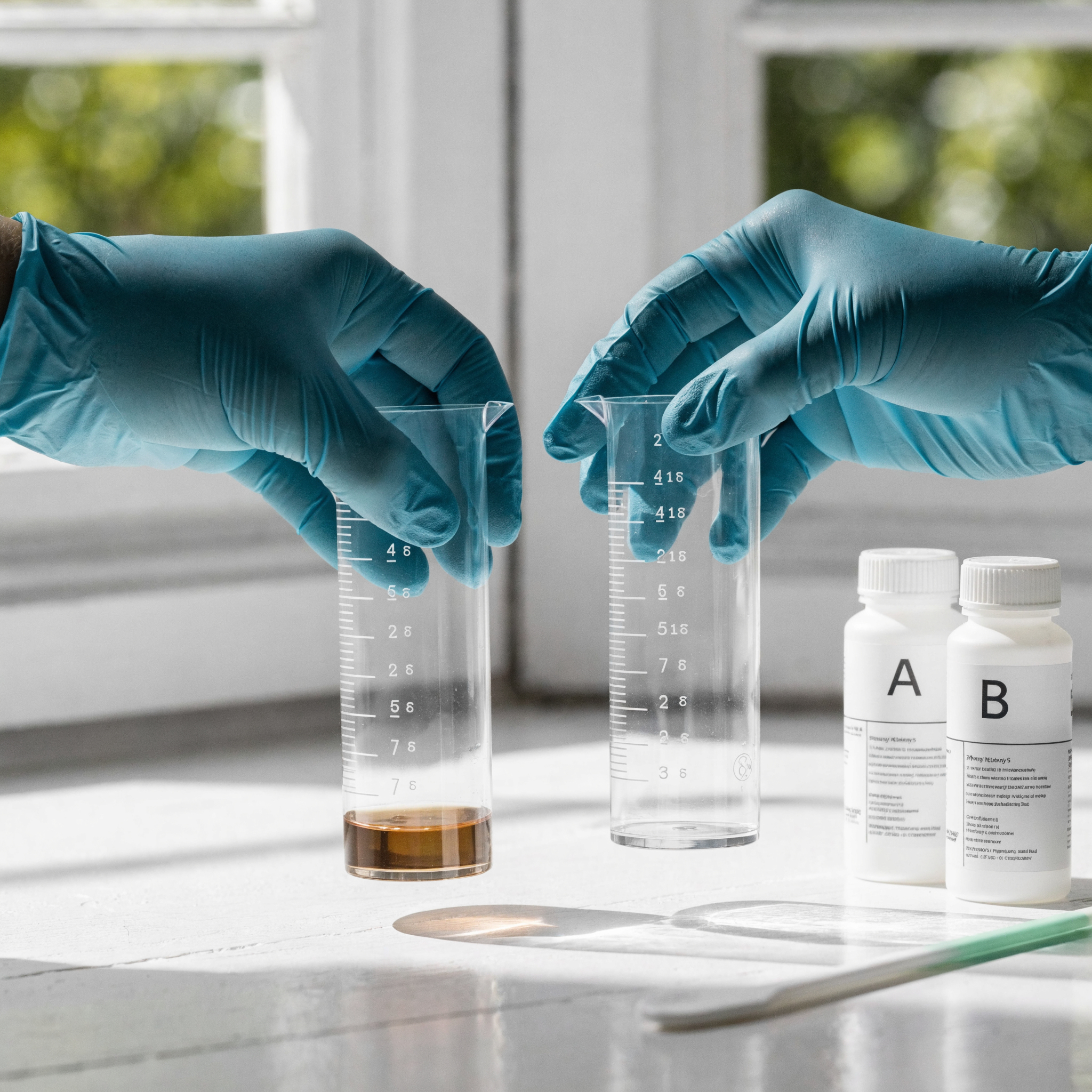
You’ve just unboxed your first resin kit. Two bottles sit on your table — Part A and Part B — and suddenly the whole project feels more complicated than you expected. What ratio do you use? How long do you mix? What even happens if you get it wrong? If that scenario sounds familiar, you’re in the right place. Learning how to mix epoxy resin correctly is the single most important skill in resin crafting, and this guide walks you through every step from setup to pour.
We know that feeling of overwhelm is real. Resin is a chemical reaction, not just a craft supply — and that’s actually a good thing, because it means there’s a correct process you can follow every single time. Once you understand the logic, it clicks fast.
Here’s everything this guide covers: safety gear, supplies, mixing ratios, the step-by-step two-cup method, cure times, bubble removal, troubleshooting, and the most common beginner mistakes. We’ve tested this with actual resin kits so you get honest, experience-based advice — not just what the label says.
💡 BEGINNER TIP: Save this guide. Come back to it after you read the label on your specific resin kit — every brand has slightly different instructions. The process is the same; the ratios and timing vary.
🧰 Recommended Kit for This Project
- LET’S RESIN Crystal Clear Epoxy Resin Kit (80 oz) — the kit this guide uses for its mixing-ratio walkthrough
- LET’S RESIN Heat Gun for Resin Crafts — for popping bubbles after your pour (see the bubble-removal section below)
- Nitrile Gloves — non-negotiable skin protection, per the safety tips above
- Safety Glasses — basic eye protection for mixing and pouring
Epoxy Resin Safety Tips: What Every Beginner Must Know
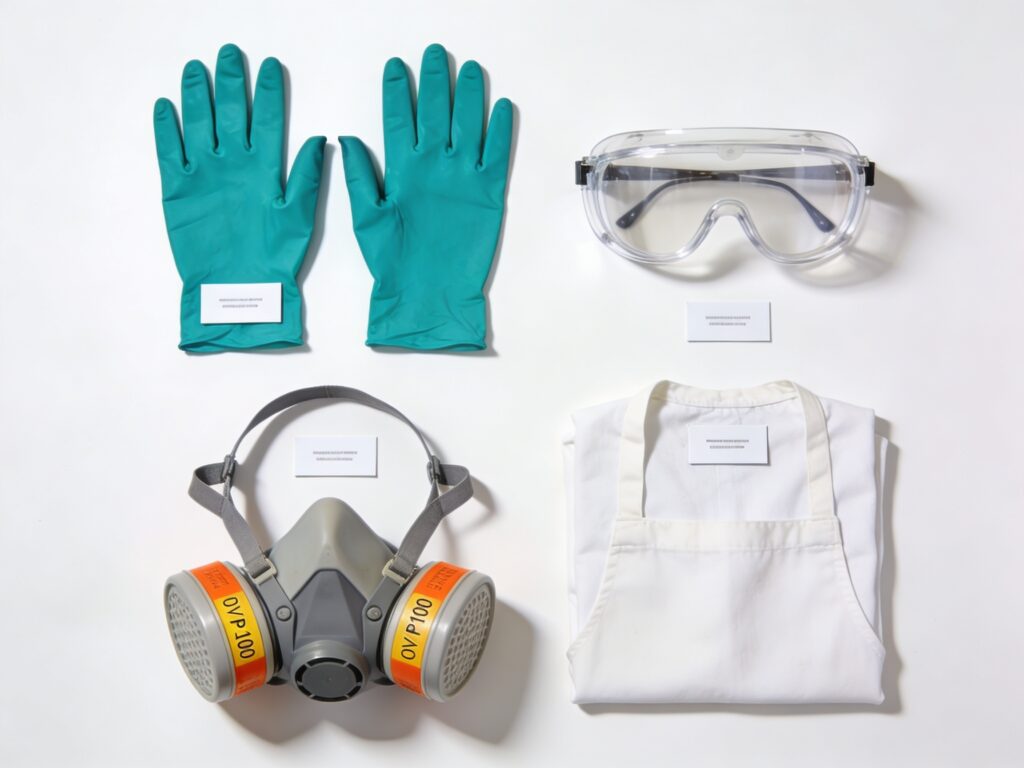
Before we talk about ratios or technique, we need to talk about safety. This isn’t the fine-print section you skim past. Epoxy resin is a two-part chemical system, and your skin and lungs need protection every single time you use it — not just the first time.
For a broader overview of the risks and precautions, read our guide answering “Is epoxy resin safe?
Epoxy resin is classified as a skin sensitizer (a substance that can trigger allergic reactions through repeated skin contact). Here’s the critical thing to understand: one exposure probably won’t hurt you. But repeated skin contact without protection can cause a permanent allergic reaction that never goes away. Once you’re sensitized, even tiny amounts of epoxy — or other acrylate-containing products like gel nail polish and dental composites — can trigger that reaction for life.
A crafter on Reddit shared a sobering account of developing a permanent acrylate allergy after handling resin craft products with only fabric gloves and no respirator over two years of low-frequency exposure. Her allergy now affects dozens of everyday products she can no longer use. This is the reality of cumulative exposure — and it’s entirely preventable.
⚠️ SAFETY WARNING: Epoxy resin is a skin sensitizer. Repeated exposure without gloves can cause a permanent allergic reaction that affects acrylate-based products for life. This sensitization is cumulative and irreversible. Nitrile gloves are non-negotiable every single time.
Do You Need Gloves When Working With Resin?
Yes — and the type of glove matters enormously. Here’s a plain-English breakdown:
- USE: Nitrile gloves (4–6 mil thickness minimum) — the best choice for resin crafting. They provide excellent chemical resistance, good dexterity, and don’t introduce additional allergy risks. Change them every 20–30 minutes, as chemical breakthrough time is limited even with nitrile.
- AVOID: Latex gloves — latex contains natural rubber proteins that can cause their own Type I allergic reactions. Since you’re already managing sensitization risk with resin, adding latex allergy risk makes no sense. Many crafters assume latex is fine because it’s used in medical settings — for resin, nitrile is the safer choice.
- AVOID: Vinyl/PVC gloves — vinyl degrades rapidly on contact with epoxy chemicals. Chemical breakthrough occurs quickly, meaning the chemicals reach your skin before you realize the glove has failed.
- AVOID: Fabric or household gloves — resin soaks through entirely. These provide zero protection.
Eye protection is next. Wear safety glasses with side shields as a minimum any time you’re handling uncured resin or hardener. Upgrade to safety goggles if you’re doing large pours where splashing is possible.
Respiratory protection often gets skipped — especially with low-odor resin formulas. This is a dangerous misconception.
⚠️ SAFETY WARNING: Standard N95 dust masks filter particles — they do NOT protect against organic chemical vapors. For resin work, you need a half-face respirator fitted with organic vapor/P100 combination cartridges (OV/P100). These are available at hardware stores and online for $20–$40. For occasional, well-ventilated sessions, this is your minimum respiratory protection.
For well-ventilated spaces (open windows, fan running), a half-face respirator with OV cartridges is sufficient for most home crafting sessions. For enclosed spaces or prolonged work, ensure your cartridges are fresh — OV cartridges have a limited service life once opened.
Ventilation is your best friend. Open a window and run a fan positioned to pull air away from you (not toward you) throughout mixing, pouring, and the first full hour of cure — when vapors are highest. Continue ventilating even after the pour is done.
💡 BEGINNER TIP: Low odor does NOT mean low hazard. Some of the most chemically active resin formulas barely smell at all. Ventilate regardless — open a window and run a fan for the entire working session, no exceptions.
📋 Get the Free Resin Safety & Prep Checklist
A one-page printable checklist covering PPE, ventilation, and workspace setup — so you’re not hunting through this guide mid-pour. Enter your email and we’ll send it straight over.
Free. We only email when there’s something useful, never more than twice a month, and you can unsubscribe anytime. Privacy Policy
What You Need Before You Start: Your Resin Mixing Supplies Checklist
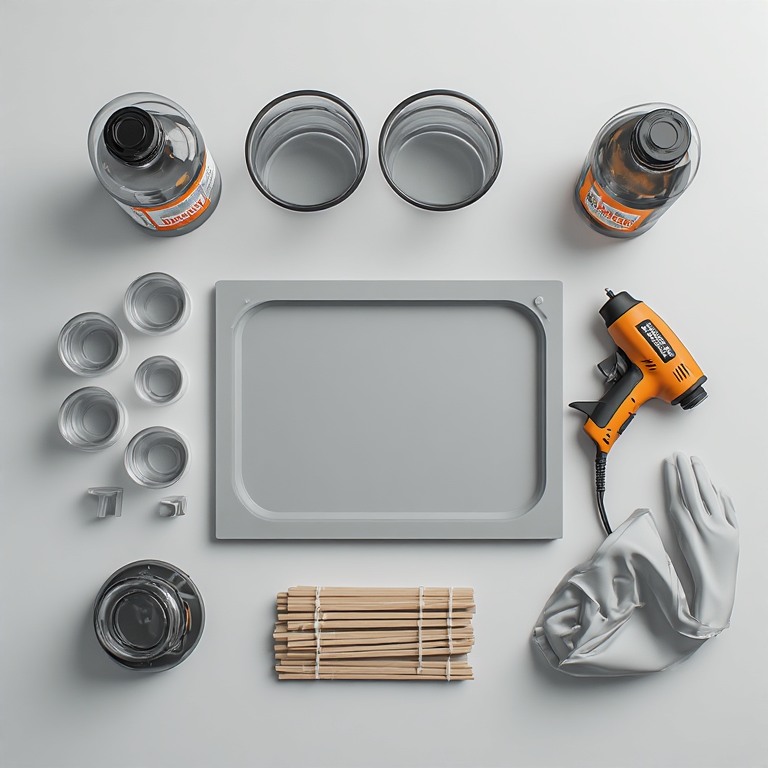
Now that your safety gear is sorted, let’s talk supplies. Having everything in place before you open your resin bottles makes the whole process calmer and more controlled. Here’s a complete checklist:
| Category | Item | Notes |
| Resin | Two-part epoxy kit (Part A + Part B) | Choose casting OR coating type for your project |
| Measuring | Two graduated plastic mixing cups | Volume markings required — do NOT eyeball |
| Mixing | Silicone or wooden stir sticks | Flat-edge preferred; silicone is reusable |
| Molds / Surface | Silicone molds or flat surface | Silicone molds: easiest for beginners; resin releases cleanly |
| Work Surface | Silicone mat or plastic sheeting | Protects from permanent staining |
| Bubble Removal | Heat gun OR 91%+ IPA in fine-mist sprayer | Hold heat gun about 6–8 inches above surface; keep moving |
| PPE — Gloves | Nitrile gloves (4–6 mil), NOT latex/vinyl/fabric | Change every 20–30 minutes |
| PPE — Eyes | Safety glasses with side shields (minimum) | Goggles for large pours |
| PPE — Respiratory | Half-face respirator with OV/P100 cartridges | NOT a standard dust mask or paper N95 |
| PPE — Clothing | Old clothes or apron; long sleeves | Resin causes permanent staining |
| Cleanup | 91%+ isopropyl alcohol or acetone | For uncured resin only — before it sets |
| Optional | Digital scale | Only if product specifies by-weight mixing |
| Optional | Timer | Track 3–5 min mixing time |
| Optional | Colorants | Mica powders, alcohol inks, resin dyes |
🛒 PRODUCT PICK: The LET’S RESIN Crystal Clear Epoxy Resin Kit (80 oz): an 80 oz kit (40 oz resin + 40 oz hardener) with a simple 1:1 ratio by volume. It self-levels, which makes it forgiving for a first project, but expect to pop surface bubbles with a torch or heat gun: the 34 oz kit we tested was not bubble free. Like every epoxy it is a skin sensitizer until it cures, so gloves and ventilation still apply, and it isn’t sold as food-safe, so treat finished pieces as decorative.
💡 BEGINNER TIP: Make sure your measuring cups have clear volume markings — fill lines at regular intervals (oz or ml). Unmarked cups make accurate measuring nearly impossible. The two-cup method (see Step 6 in the mixing guide below) also requires you to have a second clean cup ready before you start.
Casting Resin vs Coating Resin: Which One Are You Mixing?
Before you mix anything, confirm you have the right type of resin for your project. Using the wrong type is one of the most common — and most frustrating — beginner mistakes.
Here’s the simple breakdown:
Casting resin is designed to fill molds. It has a thin consistency (like pancake batter), pours deep (1–4 inches per pour), and cures slowly — usually 48 hours to 7 days. Most casting resins have a 2:1 or 3:1 ratio.
Coating resin (also called art resin or surface resin) is designed to coat flat surfaces. It’s thicker (like syrup), can only be poured up to about ¼ inch per layer, and cures faster — usually 24–48 hours. Most coating resins have a 1:1 ratio.
| Feature | Casting Resin | Coating / Art Resin |
| Purpose | Fills molds; 3D shapes | Surface coating; thin layers |
| Viscosity | Thin (like pancake batter) | Thick (like syrup) |
| Pour Depth | 1–4 inches per pour | Under ¼ inch per layer |
| Cure Time | 48 hours–7 days | 24–48 hours |
| Mix Ratio | Usually 2:1 or 3:1 | Usually 1:1 |
| Best For | Jewelry, keychains, flower preservation, mold projects | Coasters, paintings, tabletops, tumblers |
Filling a mold → Use casting resin. Covering a flat surface → Use coating resin. Using the wrong type causes serious failures.
Getting this wrong isn’t a minor setback — coating resin poured too deep into a mold builds up dangerous amounts of heat (a process called an exothermic reaction, meaning a heat-generating chemical reaction), can crack, and may never cure properly. Casting resin used as a surface coat runs off the edges and stays tacky.
❓ COMMON QUESTION: Not sure which type you bought? Check the label. Casting resin usually says “deep pour” or lists a 2:1 ratio. Coating resin usually says “1:1,” “tabletop,” or “art resin.” If you’re still unsure, check the manufacturer’s website.
For a full side-by-side comparison of both resin types — including which projects work best with each — read our complete guide to casting resin vs coating resin.
If you want a manageable first project, follow our epoxy resin coaster tutorial from preparation through curing.
Understanding Epoxy Resin Mix Ratios (1:1 vs 2:1 Explained)
The mixing ratio is the most important number on your resin kit. It tells you the proportion of resin (Part A) to hardener (Part B) you need to combine. Get it right and your resin cures beautifully. Get it wrong — even slightly — and you end up with sticky, soft, or permanently uncured resin.
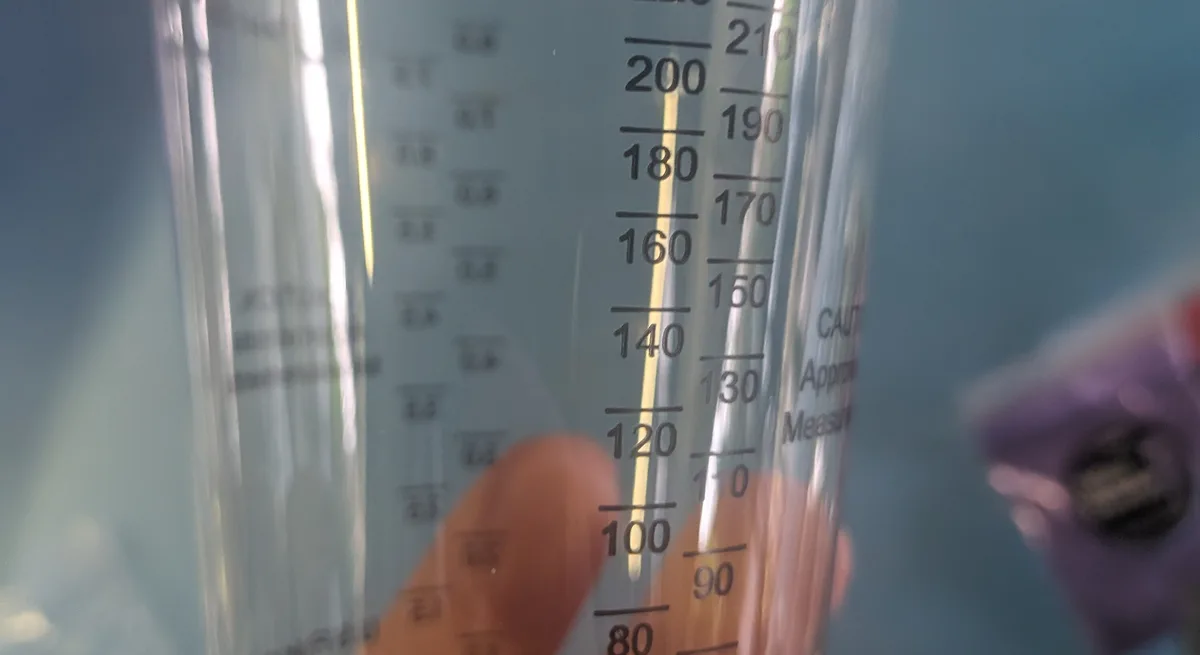
Here’s why precision is non-negotiable: epoxy resin cures through a chemical reaction between the two components. That reaction only works when both parts are present in exactly the right proportion. Too much or too little of either part leaves unreacted molecules in the mix — and those molecules stay liquid forever. If a batch is still liquid after 48 hours, here’s how to fix resin that didn’t cure.
The three ratios you’ll encounter as a beginner:
| Ratio | How to Measure | Common Products | Best For |
| 1:1 by volume | Equal parts in identically sized cups | Art/coating resins, most beginner kits | Coasters, tumblers, surface pours |
| 2:1 by volume | 2 parts resin to 1 part hardener | Some casting resins, deep pours | Jewelry, keychains, mold projects |
| 3:1 by volume | 3 parts resin to 1 part hardener | Specialty casting systems | Large mold projects, deep casting |
⚠️ SAFETY WARNING: Never guess the ratio. Even a 10% measurement error can prevent your resin from curing. Use marked measuring cups every single time — never eyeball it.
There’s also a critical distinction that trips up many beginners: volume and weight are not the same thing.
Most craft resins measure by volume (using graduated cups). This means you’re measuring the physical space the liquid takes up — like measuring cups in cooking. Volume is not the same as weight, because resin (Part A) and hardener (Part B) have different densities. A 1:1 ratio by volume does NOT equal 1:1 by weight. If you put both parts on a kitchen scale and try to match the numbers, you’ll end up with the wrong ratio.
💡 BEGINNER TIP: Volume ≠ Weight. If your kit says 1:1, that means equal VOLUME — not equal weight on a scale. Resin and hardener have different densities, so these measurement systems are NOT interchangeable. Use graduated measuring cups unless your product label specifically says “mix by weight.”
Always check your product label for the ratio before you open a single bottle. The ratio is printed clearly on every properly labeled resin kit.
How to Mix Epoxy Resin Step by Step
Now for the core process. These 8 steps follow the two-cup method — the technique professional resin artists use every time, and the single most reliable way to get a clean, properly mixed pour on your first attempt.
So, how do you mix epoxy resin? To mix epoxy resin, measure resin and hardener in the exact ratio on your label (usually 1:1 or 2:1 by volume). Combine them in a clean cup and stir slowly for 3–5 minutes, scraping the sides and bottom. Transfer to a second cup and mix for 2 more minutes before pouring.
Not sure how much to mix? Work it out first with my resin calculator, so you measure the right amount of each part.
Here’s the full process, step by step:
- Gather your supplies. Resin, hardener, two graduated mixing cups, stir sticks, and your nitrile gloves. Have everything within reach before you open the bottles.
- Check your product’s mixing ratio. Read the label — is it 1:1, 2:1, or 3:1 by volume? These are the most common ratios for craft resins.
- Measure the correct amount of resin (Part A) into your first mixing cup using the volume markings. Use the exact amount your project needs — no more, no less.
- Add the correct amount of hardener (Part B) based on your ratio. Measure it into a separate small container first if you want extra precision, then add it to Cup 1.
- Stir slowly and deliberately for 3–5 full minutes. Scrape the sides AND the bottom of the cup continuously. Mix until no ribbons, streaks, or swirls are visible. Slow is better than fast — speed whips air into the resin.
- Transfer the mixture into Cup 2 — a fresh, clean container. This step isolates your fully mixed resin from any unmixed material that may be clinging to the walls and bottom of Cup 1.
- Stir in Cup 2 for 1–2 more minutes. The mixture should look completely uniform at this point — glassy, clear, and streak-free.
- Let stand for 1–2 minutes to allow bubbles to rise, then pour immediately. Do not scrape the sides of Cup 2 while pouring.
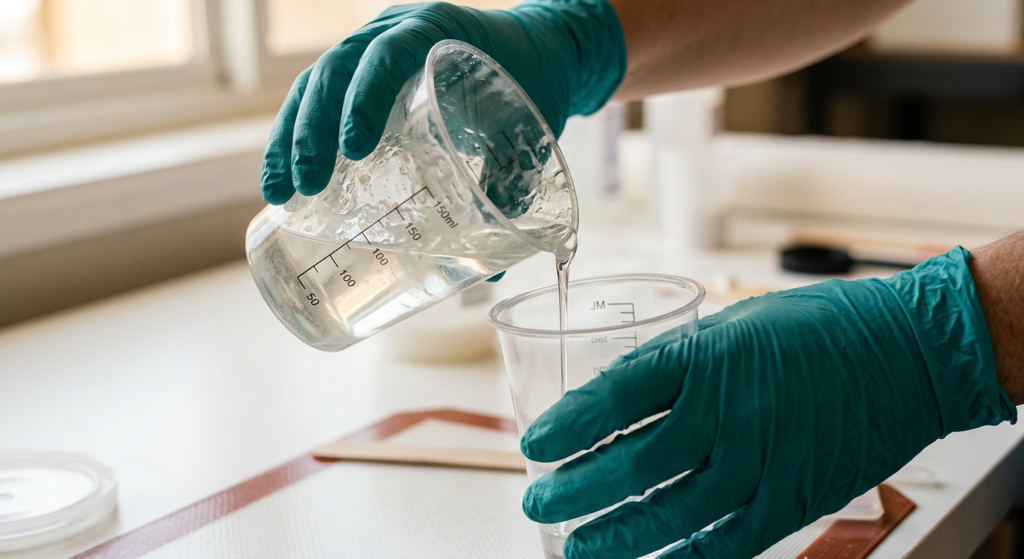
✅ PRO TIP: The two-cup method is the single most important technique in this guide. It eliminates the sticky-spot problem caused by unmixed resin clinging to the walls of Cup 1. Professional resin artists use it every single time — and once you see how it works, you won’t skip it again.
💡 BEGINNER TIP: Set a timer the moment you start mixing. Three minutes feels like forever when you’re stirring — most beginners stop at 60 seconds. The full 3–5 minutes is required for complete chemical mixing. Don’t trust your gut on this one.
✅ PRO TIP: Do NOT scrape the sides of Cup 2 while pouring. Those last few drops may contain unmixed resin that transferred during the cup swap. Leave them behind — one sticky spot ruins the whole finished piece.
How to Tell If Your Resin Is Properly Mixed
Once you’ve completed your 3–5 minutes of mixing, here’s how to check that it’s ready:
- Visually uniform: No visible swirls, streaks, or cloudiness. Properly mixed resin looks glassy and clear (or evenly tinted, if you’ve added colorant).
- Slightly warm to the touch: The cup may feel gently warm. This is the exothermic reaction (the heat-generating chemical reaction) beginning — it’s normal and expected.
- No ribbons when you lift the stir stick: Lift the stir stick slowly. If you see clear, ribbon-like streams that look different from the bulk mixture, keep mixing.
If you notice white cloudiness at this stage, your resin was likely too cold or mixed too fast. Check the troubleshooting section below.
How Long Does Epoxy Resin Take to Cure? (And What Affects It)
Patience is one of the most important skills in resin crafting. Cure time isn’t just a countdown — it’s a process that happens in four distinct stages, each with different rules about what you can and can’t do.
| Stage | Description | Timeline | Temperature Note |
| Working / Pot Time | Resin is liquid; workable; add color | 20–80 min (product-dependent) | Warm temp = shorter pot time |
| Gel Phase | Resin thickens; no longer workable | Begins after pot time | Cold temp = longer gel time |
| Initial Cure (Tack-Free) | Surface solid but soft; avoid touching | 8–24 hours | Best at 70–80°F (21–27°C) |
| Full Cure | Maximum hardness; safe to use/wear | 24 hours–7 days | Below 65°F may prevent full cure |
Temperature has an outsized effect on curing. For every 18°F (10°C) increase in temperature, your gel time is cut roughly in half. For every 18°F drop, working time doubles. The ideal working temperature for most craft resins is 70°F–80°F (21°C–27°C). Below 65°F (18°C), resin may cure incompletely or not at all — regardless of how carefully you mixed it.
💡 BEGINNER TIP: Cold resin is the most common reason first pours fail. If your workshop is below 70°F (21°C), stand the capped bottles in warm (not hot) tap water for 10–15 minutes, then dry them before mixing. The bottles should feel comfortably warm, not hot. Never use boiling water — it accelerates curing too fast and can damage the resin.
One more thing to address here, because it comes up constantly: Can I add more hardener to make it cure faster? No — adding extra hardener does the opposite of what you want. The reaction requires an exact chemical balance. Altering that balance leaves unreacted molecules in the mix, resulting in soft, sticky, or permanently uncured resin. To speed up curing, warm your workspace temperature instead. That’s the only reliable lever you have.
Cover your curing piece with a dust tent — an upturned cardboard box or plastic storage container works perfectly. Don’t move it, touch it, or add more resin during the gel phase. Any disturbance while curing causes surface imperfections that can’t be fixed.
How to Remove Bubbles from Your Epoxy Resin Pour
Bubbles are one of the most common complaints from beginner crafters — and the good news is that most of them are preventable and fixable. The main causes are mixing too fast and skipping the two-cup method. If you followed the steps above correctly, you’ll already have fewer bubbles than most first-timers.
Here’s how to handle any that remain:
Method 1: Heat gun or propane torch
Wait 2 minutes after pouring before you reach for any heat tool — bubbles need time to rise to the surface. Then pass a heat gun or torch in a slow, sweeping motion about 6–8 inches (heat gun) or 4–6 inches (torch) above the resin surface. The heat briefly reduces surface tension, allowing bubbles to pop. Keep moving — never hold the heat in one spot or you’ll scorch the surface.
Return every 10–15 minutes during the first hour of cure. New bubbles will continue rising as you watch, so multiple passes are normal.
Method 2: IPA spray (no torch needed)
If you don’t have a heat gun or you’re uncomfortable with open flames, 91% or higher isopropyl alcohol (IPA) in a fine-mist spray bottle works well. Lightly mist the surface from 6–8 inches away. The alcohol briefly dissolves surface tension, letting bubbles pop on contact. Use one light mist only: too much alcohol can leave dimples or soft spots, and it’s flammable, so never use it near a torch or other flame.
🛒 PRODUCT PICK: The LET’S RESIN Heat Gun for Resin Crafts is purpose-built for resin work — it includes a round nozzle specifically designed for bubble removal, plus built-in overheat protection. Hold it 6–8 inches above the surface and keep it moving in slow, sweeping passes to avoid scorching.
✅ PRO TIP: Always wait at least 2 minutes after pouring before using any heat tool. Rushing straight to the torch while the resin is still settling just pushes bubbles deeper instead of popping them. Time and patience matter more than technique here.
For an in-depth guide to eliminating bubbles before and after the pour — including prevention techniques — read our full article on how to get bubbles out of resin.
Why Is My Resin Sticky? Troubleshooting Common Mixing Mistakes
Sticky resin is the number one complaint from first-time crafters. Before we get into the full troubleshooting table, here’s a quick framework that makes diagnosis easy.
Incorrect Ratio vs Under-Mixing: How to Tell the Difference
These two problems feel the same — sticky resin — but they have different patterns:
- Wrong ratio: Sticky everywhere. The entire piece is uniformly soft or gooey. No hard spots. This points to a ratio error.
- Undermixing: Sticky patches in an otherwise curing piece. Some areas are hard, some are tacky. This points to incomplete mixing — unmixed material from the sides or bottom of the cup made it into your pour.
Now here’s the full troubleshooting table:
| Symptom | Root Cause | Fix |
| Sticky all over after 24 hrs | Wrong ratio OR undermixing | Check ratio; start fresh batch; warm workspace |
| Sticky patches / soft spots | Unmixed material from cup edges (skipped two-cup method) | Use two-cup method next time; this batch may be unsalvageable |
| Cloudy / milky / white result | Mixing too fast (air whipped in), cold temps, or humidity | Work at 70°F+; mix slowly; reduce humidity |
| Excessive bubbles trapped | Mixed too fast; no heat gun used | Mix slowly; use heat gun or IPA spray within 2 min of pouring |
| Resin got very hot / cracked | Poured too deep with coating resin; batch too large | Use casting resin for deep pours; stay within ¼ inch per layer for coating resin |
| Never hardened at all | Wrong ratio; wrong product type; cold temps | Verify ratio; check product type; warm workspace to 70°F+ |
| Resin still bendy after full cure time | Cold workspace during cure; incomplete ratio | Ensure workspace stays warm (70°F+) throughout full cure cycle |
💡 BEGINNER TIP: If your resin is sticky all over after 24 hours, the honest answer is: this batch likely can’t be saved. The most productive next step is to figure out what went wrong — ratio or temperature — and start a fresh batch with that correction in place. Don’t try to pour more resin on top of an uncured sticky layer.
For a deeper dive into every sticky resin scenario and what you can do about each one, read our full why is my resin sticky troubleshooting guide.
What to Do After Mixing: Pouring, Spreading, and Protecting Your Work
You’ve mixed correctly, your resin looks clear and uniform, and you’re ready to pour. Here’s how to finish the job properly.
Pouring technique: Pour slowly and steadily into your mold or onto your surface. Don’t rush. Fast pouring introduces more air and splashes resin where you don’t want it. Let it flow from the cup naturally.
Do NOT scrape the sides or bottom of Cup 2 while pouring. Those last drops at the rim and base may contain unmixed resin that traveled with the transfer. Leave them in the cup — a few lost drops are better than a sticky spot in your finished piece.
For porous surfaces like raw wood or canvas: apply a thin seal coat first. Let it reach initial tack (sticky but not wet), then apply your working layer. This prevents the porous material from absorbing resin and creating an uneven surface.
Spreading on flat surfaces: Use a silicone brush or spreader and work from the center outward. Let the resin self-level as much as possible — epoxy resin is self-leveling, meaning it naturally flows to an even thickness when given time.
After pouring: Remove bubbles (see the section above), then cover your project with a dust tent. An upturned cardboard box or plastic storage tub with enough clearance above the surface works perfectly. Keep dust, pet hair, and insects away during the entire cure period.
Do not move, touch, or disturb the piece during the gel phase. Any contact creates surface imperfections that cannot be removed without sanding and a second pour.
Cleanup:
Wipe tools and mixing cups with paper towels sprayed with 91%+ isopropyl alcohol or acetone before the resin sets. Once cured, resin is extremely difficult to remove from tools. Silicone tools have an advantage here — cured resin peels off cleanly.
⚠️ SAFETY WARNING: Never pour uncured liquid resin down the drain. It hardens inside pipes and is an environmental hazard. Pour any leftover mixed resin into a silicone cup or mold, let it fully cure to a solid, then dispose of the solid piece in the regular household trash.
One more important note on skin contact cleanup: if resin touches your skin, don’t use solvents to remove it. Solvents (acetone, IPA) can drive chemical compounds deeper into skin tissue. Use a waterless skin cleanser first, then wash with soap and warm water.
Common Beginner Mistakes to Avoid
These are the mistakes that cause the most first-pour failures. Every one of them is more common than you’d expect — and every one of them is easy to avoid once you know it’s a risk.
Mistake 1: Eyeballing the ratio
“Close enough” isn’t a concept epoxy resin understands. Even a 10% measurement error in either direction can prevent proper curing. Use marked measuring cups every single time, no exceptions.
Mistake 2: Mixing too fast
Many beginners assume faster stirring means better mixing. It doesn’t. Stirring quickly whips air into the resin, creating microfoam bubbles that are extremely difficult to remove. Slow, deliberate stirring in a scraping motion is correct.
Mistake 3: Stopping too soon
Thirty seconds of mixing is not three minutes of mixing. Most beginners undermix significantly because the time feels long. Set a timer. The full 3–5 minutes is non-negotiable for complete chemical integration.
Mistake 4: Skipping the second cup
The two-cup method isn’t optional advice — it’s the technique that prevents soft spots. Unmixed resin clings to the walls and bottom of Cup 1. If you pour directly from Cup 1, that unmixed material goes into your piece.
Mistake 5: Scraping Cup 2 while pouring
Every last drop isn’t worth a sticky spot in your finished piece. Leave the last residue in the cup. Those edge drops may contain unmixed material from the transfer.
Mistake 6: Working in cold temperatures
Below 65°F (18°C), resin cures unreliably or not at all — regardless of mixing technique. Warm your workspace, warm your bottles, and maintain that temperature throughout the full cure period.
Mistake 7: Adding extra hardener to fix sticky resin
This is one of the most damaging myths in resin crafting. Extra hardener doesn’t fix sticky resin — it disrupts the chemical balance and makes curing worse. The fix is a fresh batch with the correct ratio.
Mistake 8: Skipping PPE
“It’s just a craft project” is how sensitization starts. Epoxy resin is a real chemical system with real exposure risks. Gloves, safety glasses, and ventilation are required for every session — not just the messy ones.
⚠️ SAFETY WARNING: “It barely smells” is not a safety assessment. Low-odor resin formulas can be just as chemically active as strong-smelling ones. Sensitization risk doesn’t depend on smell intensity. Always use PPE and ventilation regardless of odor level.
💡 BEGINNER TIP: Print this list and keep it next to your workspace for your first three pours. Every one of these mistakes is more common than you think — even among crafters who’ve been doing this for years. A quick checklist glance before you open the bottles takes 30 seconds and saves hours of frustration.
Product Recommendations for Beginners
Choosing your first resin kit can feel overwhelming. Here’s an honest comparison of three products we recommend for beginners, with clear notes on who each one suits best.
| Feature | LET’S RESIN Crystal Clear 80oz | ArtResin Starter Pack (32oz) | MAS Epoxies Art Pro |
| Mix Ratio | 1:1 by volume | 1:1 by volume | 1:1 by volume |
| Working Time | 30–40 min | ~45 min | 60 min |
| Cure Time | Demold 8–24 h; full cure 2–3 days (per Let’s Resin) | 24 h touch-dry, 72 h full cure | Approx. 24–72 hrs (check product SDS) |
| Includes Tools | Yes (cups & sticks) | No | No |
| Best For | Budget-friendly beginner kit | Small Starter Kit | Longer working time; detail work |
LET’S RESIN Crystal Clear 80oz Kit
This is our top recommendation for first-timers: an 80 oz kit (40 oz resin + 40 oz hardener) with a simple 1:1 ratio by volume. It self-levels, which makes it forgiving for a first project, but expect to pop surface bubbles with a torch or heat gun: the 34 oz kit we tested was not bubble free. Like every epoxy it is a skin sensitizer until it cures, so gloves and ventilation still apply, and it isn’t sold as food-safe, so treat finished pieces as decorative. We tested the 34 oz kit from the same range on two real pours. See our hands-on review of the Let’s Resin 34 oz kit for cure times, bubbles and what was missing from the box.
ArtResin 32oz Starter Pack
ArtResin is a premium, two-part crystal-clear epoxy resin designed specifically for artists and crafters. This 32oz starter kit (typically 16 oz resin + 16 oz hardener) cures to a high-gloss, glass-like finish that enhances colors and details in artwork, photos, wood, and mixed-media pieces. Formulated to be non-toxic when used as directed, low-odor, and UV-resistant to help reduce yellowing over time, ArtResin is easy to mix (commonly 1:1 by volume) and self-levels for a smooth, professional result. It’s ideal for resin art, painting pours, coasters, jewelry, tabletops, and other small-to-medium projects where clarity, durability, and a food-safe* finish are desired (when fully cured and used as directed).
MAS Epoxies Art Pro
MAS Epoxies Art Pro is a professional-grade, two-part clear epoxy resin system designed for artists, woodworkers, and makers who need a durable, high-gloss finish. Typically mixed at a 1:1 ratio by volume, it cures to a hard, crystal-clear surface with excellent leveling properties, making it ideal for resin art pours, river tables, bar tops, countertops, coasters, and other coating/casting projects. Formulated for low yellowing and strong UV resistance (relative to many general-purpose epoxies), Art Pro delivers a smooth, glass-like finish that enhances color and depth. This kit includes resin (Part A) and hardener (Part B)—tools and accessories are sold separately.
One honest caution for all three: No kit can compensate for incorrect mixing. Product quality matters, but technique matters more. The 8-step process in this guide applies to all of them.
Frequently Asked Questions
Why is my resin still sticky after 24 hours?
Sticky resin after 24 hours is almost always caused by an incorrect mixing ratio, undermixing, or a cold working environment (below 65°F / 18°C). Check that you used the exact ratio printed on your product label — measured by volume, not weight — and that you mixed for the full 3–5 minutes, scraping the sides and bottom throughout. If you’re confident the ratio was correct, warm your workspace to at least 70°F and give it another 24 hours before concluding the batch is unsalvageable.
Do I need to use gloves when working with resin?
Yes — nitrile gloves are essential every time you work with epoxy resin. Epoxy is a skin sensitizer: repeated skin contact without protection can cause a permanent allergic reaction that doesn’t go away and affects other acrylate-containing products (like gel nail polish and dental composites) for life. Use nitrile gloves specifically — not latex, vinyl, or fabric — and change them every 20–30 minutes.
What ratio do I mix epoxy resin?
The ratio depends entirely on your specific product — always check the label first. Most beginner and art/coating resins use a 1:1 ratio (equal parts resin and hardener by volume). Some casting resins use 2:1 (two parts resin to one part hardener by volume). Never guess or adjust the ratio — even a small error causes sticky or permanently soft resin.
How long does epoxy resin take to cure?
Most craft epoxy resins reach an initial cure (tack-free surface) in 8–24 hours and a full cure in 24 hours to 7 days — it varies by product, temperature, and pour thickness. Wait for the manufacturer’s specified full cure time before sanding, polishing, or using your piece. Cold temperatures significantly slow curing: work at 70°F–80°F (21°C–27°C) for best results.
Can I add more hardener to make my resin cure faster?
No — and this is important. Adding extra hardener does not speed up curing and actively prevents the resin from curing properly. Epoxy resin requires an exact chemical balance. Altering that balance leaves unreacted molecules in the mix, resulting in soft, sticky, or permanently uncured resin. To speed up curing, warm your workspace temperature slightly instead — that’s the only reliable method.
What is the difference between casting resin and coating resin?
Casting resin is thin (low viscosity), designed to fill molds, and can be poured 1–4 inches deep — it cures slowly (48 hours to 7 days) and usually has a 2:1 or 3:1 ratio. Coating resin is thicker, designed for flat surfaces like coasters and tabletops, can only be poured up to ¼ inch per layer, cures faster (24–48 hours), and usually has a 1:1 ratio. Using the wrong type for your project causes serious failures: coating resin in deep molds overheats and cracks; casting resin on surfaces stays runny and tacky.
Why is my resin cloudy?
Cloudy or milky resin is usually caused by one of three things: mixing too fast (which whips air and moisture into the mixture), working in a cold environment (below 65°F / 18°C), or high humidity in the workspace. Warm your workspace and resin bottles to 70°F+ before mixing, and stir slowly using a deliberate scraping motion. Humidity above 70% can also cause cloudiness — avoid mixing on rainy days in uncontrolled environments when possible.
You’re Ready for Your First Pour
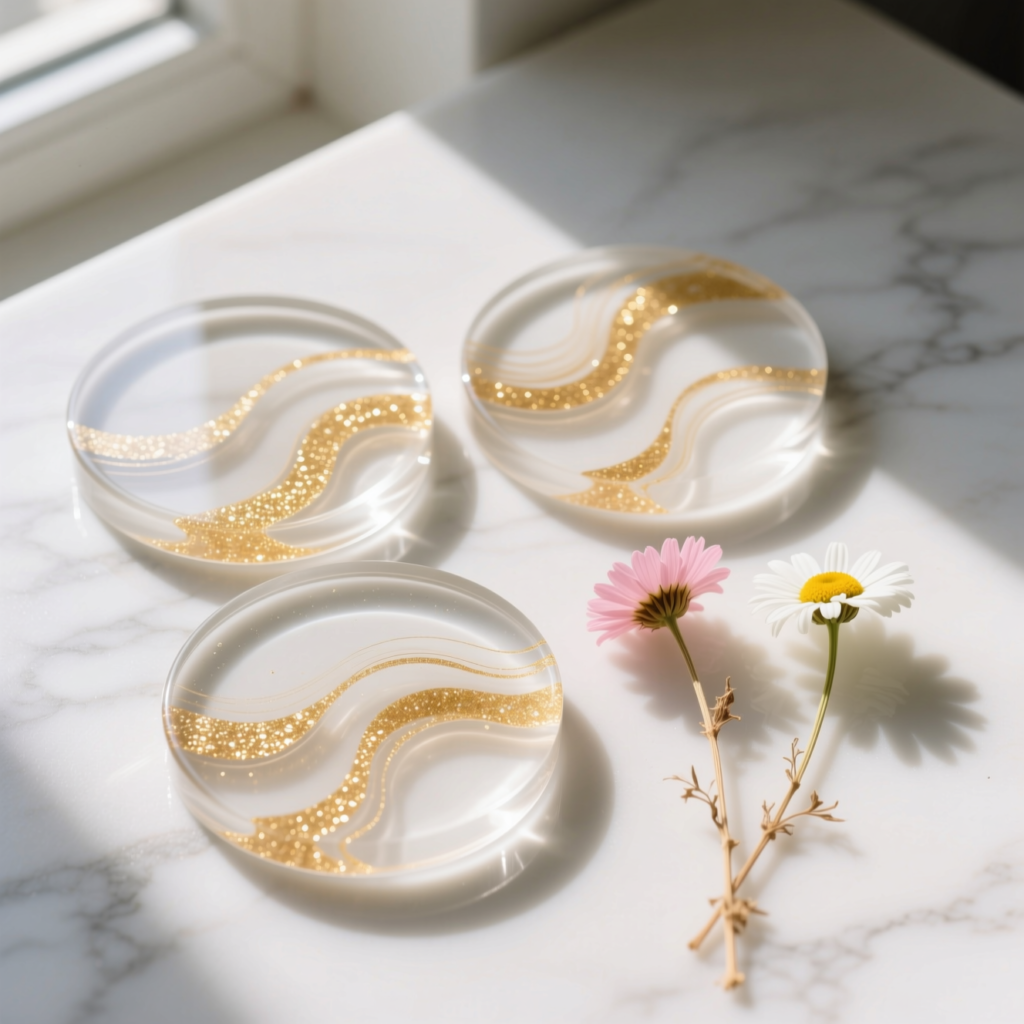
You now know everything you need for a successful first pour. Let’s bring it together into three things worth remembering above all else.
First, get your ratio right every time — measure by volume using marked cups, follow the label exactly, and never guess. Second, mix thoroughly using the two-cup method — slow deliberate stirring for the full 3–5 minutes, followed by a transfer to a fresh cup. Third, protect yourself and your workspace — nitrile gloves, safety glasses, and ventilation are required for every session, not just the messy ones.
Learning how to mix epoxy resin is a skill that clicks quickly once the logic makes sense. Your first pour may not be perfect — and that’s completely fine. Every imperfection teaches you something specific that will make the next one better.
Ready to put your new skills to work? Check out our guide to easy epoxy resin projects for beginners — each one includes a full supply list and step-by-step instructions sized for a beginner’s first few sessions.
Want to make sure your safety setup is complete before you start? Our full resin safety checklist for beginners walks you through every piece of PPE, ventilation setup, and disposal step in one place.
Bookmark this page. The troubleshooting section is here whenever a pour goes sideways — and it happens to every crafter at some point. Come back to it, find your symptom, and you’ll know exactly what to do next. Now go make something.
Keep Learning on ResinAffairs.com
Put your mixing skills to work. Here’s where to go next:
- ☕ How to Make Epoxy Resin Coasters → — the classic first project, with a full supply list and troubleshooting.
- 🧩 Best Resin Molds for Beginners → — silicone vs. plastic vs. DIY molds, and which one to buy for each project.
- 🥤 Resin Tumblers for Beginners → — how to coat your first epoxy tumbler on a turner without drips.
- 🩹 Common Resin Problems and How to Fix Them → — fixes for stickiness, bubbles, soft spots and cracks on any resin project.
- 🪣 Epoxy Pouring for Beginners: Step-by-Step → — pour technique, bubble removal, and the mistakes that cause the most redo pours.
- How long does resin take to cure →
Enjoyed this guide? Join the Resin Affairs newsletter for new tutorials, safety tips, and project ideas straight to your inbox.