How to Sell Resin Crafts Online (and What It Really Costs)
Quick answer: work out what one piece really costs you, including your time. Price it to cover materials, labor and marketplace fees. Start on one marketplace. Before you list anything, check three things: what you can honestly say about food contact, whether the item counts as a children’s product, and how you’ll handle tax.
General information for US sellers, not legal or tax advice. Fees, prices and rules were checked on October 15, 2026, and they change, so check each source before you rely on it.
I bought the kit and the molds in this post with my own money. Nobody sent them to me or paid for this post. If you buy through my links I may earn a small commission at no extra cost to you.
As an Amazon Associate I earn from qualifying purchases.
Most “resin crafts to sell” articles give you a list of ideas and stop there. This one starts with a real batch from my bench, a set of four coasters and a holder, and costs it out line by line. Then it covers how to price, what the marketplaces take, and the rules that most guides skip. I also sell other handmade goods on Etsy. I haven’t sold resin there, so everything about resin below comes from my own pours and from the sources listed at the end.
What does one resin piece really cost to make?
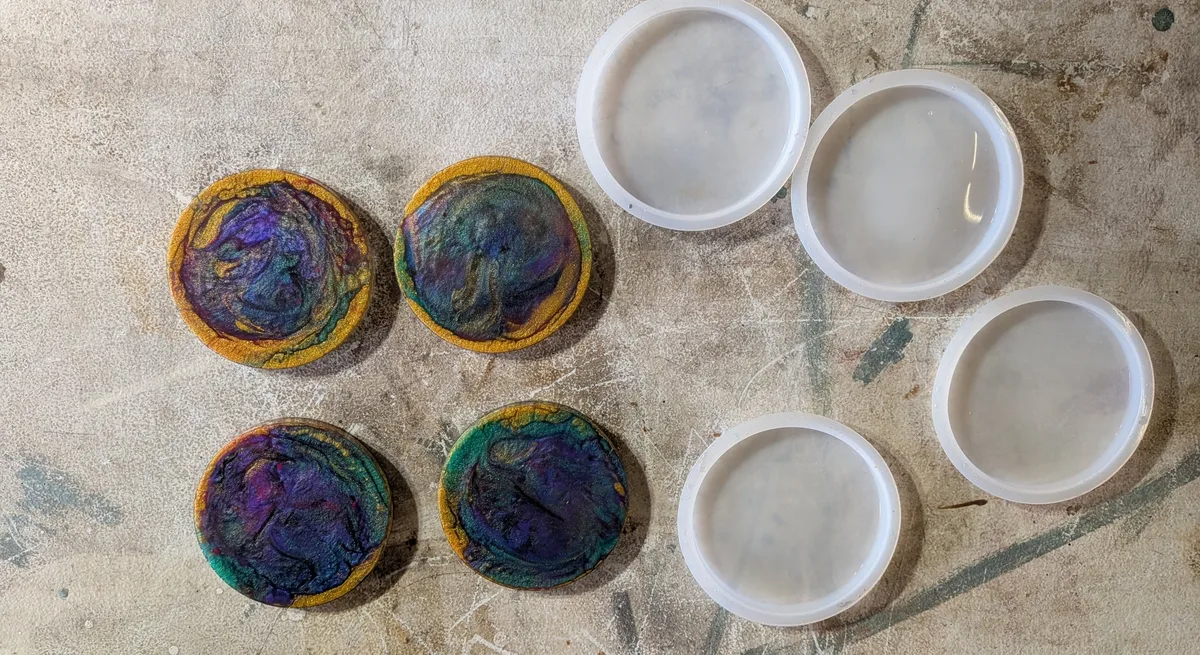
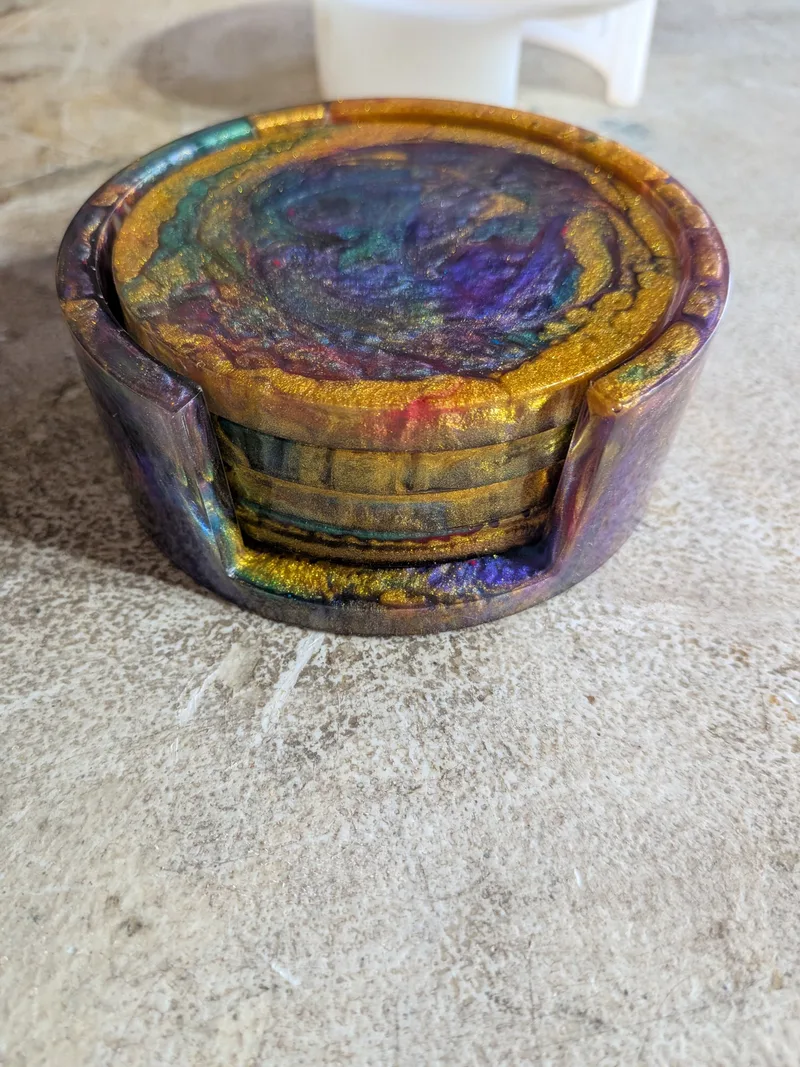
Here’s the batch: four round coasters and a matching holder, poured on October 12 with the Let’s Resin 34 oz starter kit I reviewed. I mixed 9 oz in total. That figure includes a little leftover that I brushed onto another project, so the coasters themselves used slightly less. For color, I scooped a small heap of each of the kit’s mica powders on a popsicle stick. I wore two pairs of nitrile gloves. I always wear gloves to pour, even for a small batch. The pieces stayed in their molds for about three days.
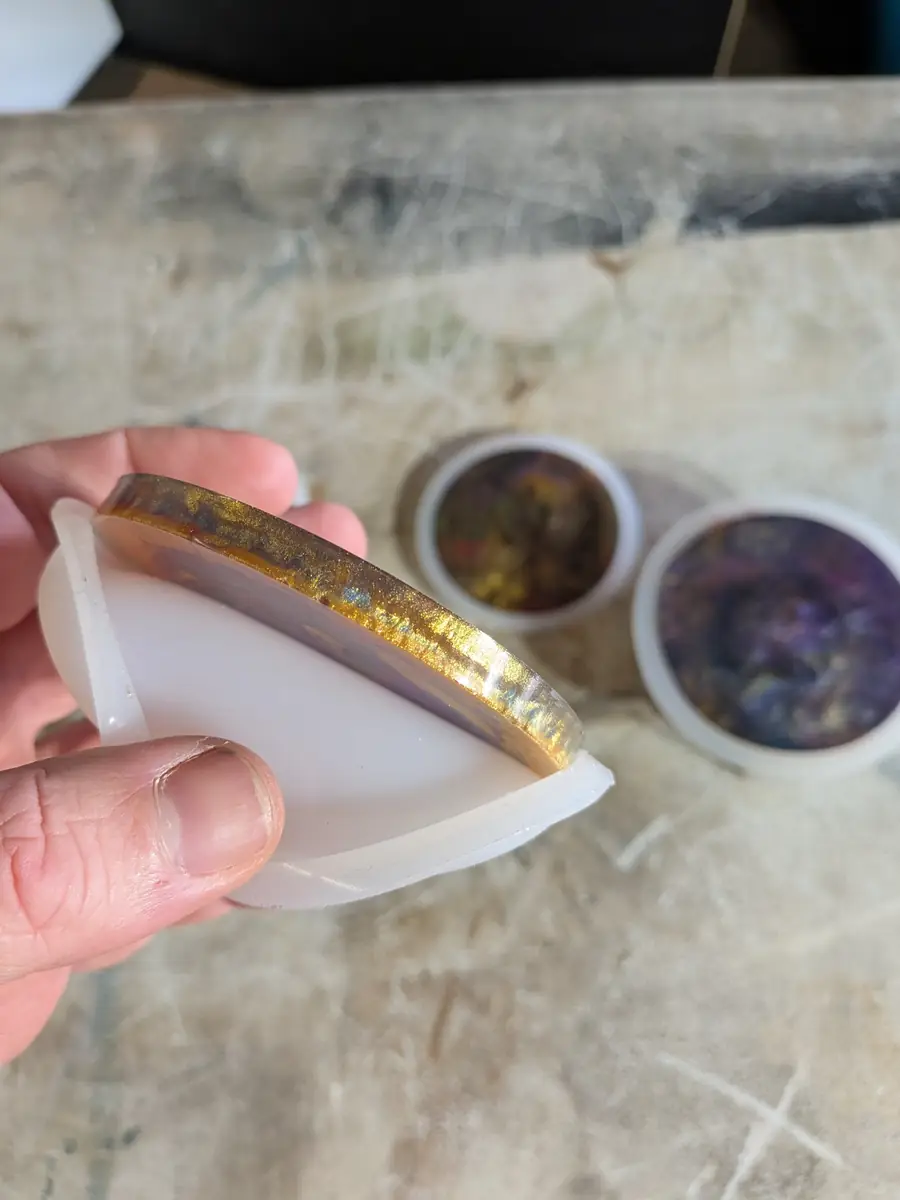
They came out of the molds glossy and hard, so I didn’t sand them. That matters for cost, because sanding is where the hours go (more on that with the ornaments below). Here’s what the batch cost at today’s US prices:
| Item | How I worked it out | Cost |
|---|---|---|
| Resin, plus a share of the kit’s mica, cups and sticks | 9 oz of a 34 oz kit at $20.99 | $5.56 |
| Nitrile gloves | 2 pairs from a box of 100 at $21.48 | $0.86 |
| Silicone molds | An 18-mold set at $17.99, spread over about 20 batches (my estimate) | $0.90 |
| Popsicle stick, baking paper, tape | Pennies; not counted | – |
| Materials | $7.32 | |
| My time | About 1½ hours (set-up, pour, demold) at $7.25 an hour, the federal minimum wage | $10.88 |
| Break-even for the set | $18.20 |
Two things stand out. First, none of the consumables looks like much on its own, but they add up across a batch: gloves and the molds’ share took this set from about $5.50 in resin to over $7. Second, the biggest cost isn’t the resin at all. It’s your time, even at minimum wage. If you value your hour at more than $7.25, and most people would, every number below goes up.
To work out the resin for your own molds before you buy, the resin calculator gives you the total and the Part A and Part B split. If you want to follow this exact batch, the full method is in my resin coasters tutorial.
The batch that doesn’t pay: my Christmas ornaments
Compare that with the wood and resin snowflake ornaments I made earlier. There were three of them, cut on my laser from beech off-cuts that cost me about $0.70 each (A$1; 1 AUD = 0.697 USD on October 14, 2026). They used 6 oz of resin over three pours and six pairs of gloves. Then came 1 to 2 hours of trimming, sanding up to 400 grit and a clear top coat, plus about half an hour of laser time.
Materials came to about $8.37 for the three, or roughly $2.80 each, before sandpaper and clear coat. Add 2½ hours at minimum wage (finishing at the top of my range, plus the laser time) and the break-even is about $8.80 per ornament. Run that through the pricing formula below and it says to charge about $35 each. My honest verdict: it’s not a cost-effective project. If I were selling them, I’d change two things: I’d make them in bulk, or use a CO2 laser instead of my diode laser. Coasters poured straight into a good mold skip most of that finishing, and that’s why I costed them here instead.
How do you price resin crafts?
Etsy’s own seller handbook gives a simple formula that I find useful:
- Break-even price = supplies + overhead + labor
- Wholesale price = break-even × 2 or more
- Retail price = wholesale × 2 or more
For my coaster set that gives $18.20 break-even, $36.40 wholesale and $72.80 retail. That number is the real answer to “is selling resin crafts profitable?” The formula covers your costs and a margin, and the result is often more than a beginner feels able to ask. Many new sellers price somewhere near the wholesale figure at first. That’s your call, but do it knowing what you’re giving up, not by guessing.
Where can you sell resin crafts online?
| Where | What it costs (checked October 15, 2026) | Good to know |
|---|---|---|
| Etsy | $0.20 per listing (listings expire after four months); 6.5% transaction fee on the item price plus shipping and gift wrap; US payment processing 3% + $0.25; Offsite Ads 15% on sales they bring in, for shops under $10,000 a year; a possible one-time set-up fee, shown when you open the shop | The biggest handmade audience. In the states where it’s a registered sales tax vendor, Etsy collects and sends the tax for you |
| Amazon Handmade | Needs the Professional selling plan ($39.99 a month), but Amazon waives the monthly fee for approved Handmade sellers after the first month. Amazon’s fee schedule lists a 15% referral fee (minimum $0.30) for Home and Kitchen items like coasters | You apply to join, and makers are vetted. Check the referral rate for your category when you apply |
| Your own website (Shopify or similar) | A monthly plan fee plus card processing; Shopify shows plan prices for your country on its pricing page | You keep more of each sale, but you have to bring every buyer yourself |
| Local markets and craft fairs | Stall fees vary by event | Good for testing prices face to face before you list online |
What does Etsy take from a sale?
Here are the Etsy fees on my coaster set at two prices, with free shipping and before sales tax:
| At the formula price, $72.80 | At a beginner price, $35 | |
|---|---|---|
| Listing fee | $0.20 | $0.20 |
| Transaction fee (6.5%) | $4.73 | $2.28 |
| Payment processing (3% + $0.25) | $2.43 | $1.30 |
| Etsy’s fees | $7.36 | $3.78 |
| Left after fees and materials ($7.32) | $58.12 | $23.90 |
| That’s per hour of my time (1½ hours) | About $38.75 | About $15.93 |
| If the sale came through Offsite Ads (add 15%) | $10.92 more in fees | $5.25 more in fees |
At $35, the set still pays about $16 an hour, or about $12 if the sale came through Offsite Ads. But that leaves nothing for overhead, photos, packing time or the coasters that don’t come out right.
Four rules most selling guides skip
1. “Food safe” is a claim you have to be able to back up
The FDA puts the responsibility on the manufacturer of a food-contact material to make sure it meets the rules, and food-contact claims rest on what the resin maker has tested. Even then, the claim has conditions. ArtResin, for example, says its food-safety testing used pure resin with no colorants, mixed 1:1, torched and cured for 72 hours. It says the cured resin shouldn’t touch anything hotter than 120°F (50°C), and that adding colorants can compromise its food-safe status. So a tinted serving board or tray shouldn’t be listed as food safe on your say-so. If your resin maker doesn’t make the claim for the way you’ve used it, don’t make it in your listing. (More on this in Is epoxy resin safe?)
2. Anything aimed at kids 12 and under is a children’s product
US law defines a children’s product as one designed or intended primarily for children 12 or younger. The CPSC says children’s products need third-party testing and a written Children’s Product Certificate. How you describe and photograph the item counts towards that decision, so “perfect for kids” in a listing matters. Products for children under 3 can’t have small parts that are a choking hazard. Resin jewelry and keychains are the usual traps here.
3. Tax: report the income, form or no form
Online marketplaces have to send you a Form 1099-K when your payments for goods total over $20,000 in more than 200 transactions. But the IRS is clear that, whatever the amount, you must report all income from selling goods on your tax return. Sales tax is separate: Etsy collects and sends it for you in the states where it’s registered, and its help page lists those states. For anything beyond that, ask a tax professional.
4. Ship when you said you would, and think about insurance
Under the FTC’s mail order rule, you must have a reasonable basis for any shipping time you state. If you don’t state one, you need to be able to ship within 30 days. If you can’t, you have to ask the buyer’s consent to the delay. And before you sell anything that holds a hot drink or might end up near children, it’s worth asking an insurer about product liability cover.
Photos, listings and the care card
- Photograph the real piece in daylight, and include one shot that shows the scale (a cup on a coaster works).
- Say what it is and what it’s made of: size, epoxy resin, mica color, and whether it’s sealed underneath.
- Don’t promise what you can’t back up: no “food safe” or “heat proof” unless the resin maker says so for the way you made it.
- Put a care card in the box: hand-wash only; keep it away from hot pans and direct sun, because cured craft epoxy can soften from about 120°F (50°C). The sun also yellows resin over time.
Packing and shipping
Wait for the full cure on the label before you pack anything. That’s about 7 days for most craft epoxy, even though pieces feel hard much sooner (see how long resin takes to cure). A piece that’s still curing can pick up marks from the packing. Wrap each coaster separately so the faces can’t rub; my resin gift-wrapping guide covers padding that won’t scratch. USPS Priority Mail includes up to $100 of insurance with most shipments (restrictions apply), which is worth knowing when you price shipping.
Frequently asked questions
Is selling resin crafts profitable?
It can be, but often less than people expect. My four-coaster set cost $7.32 in materials, and the time cost more than the resin. Etsy’s pricing formula puts it at about $73. At a beginner price of $35, I’d clear about $16 an hour after fees. Work out your own numbers before you set a price.
Do I need a license to sell resin crafts?
It depends on where you live. Rules on business licenses and sales tax permits vary by state and city, so check with your state’s business and revenue offices before you start. This isn’t legal advice.
Can I sell resin coasters or trays as food safe?
Only if your resin maker says its cured product is food safe, and only under its conditions. ArtResin’s claim, for example, covers uncolored resin cured 72 hours and kept under 120°F (50°C), and it says colorants can compromise it. If the maker doesn’t back the claim for the way you made the piece, leave it out of your listing.
Can I sell resin jewelry or toys for kids?
Items designed mainly for children 12 and under are children’s products. The CPSC requires third-party testing and a Children’s Product Certificate, and small parts are banned in products for children under 3. If you’re not set up for that, don’t market the item to children.
What resin crafts sell best?
I don’t have sales data on resin, so I won’t guess. Look at what’s selling in your marketplace’s own search results, and pick pieces that are quick to make well. Coasters poured straight from a good mold beat pieces that need hours of sanding, as my ornaments showed.
Sources
- Etsy: Fees & Payments Policy: listing, transaction, Offsite Ads and set-up fees (updated Oct 5, 2026)
- Etsy: Etsy Payments Policy: US payment processing rate
- Etsy Help: How US state sales tax applies to Etsy orders: where Etsy collects and remits
- Etsy Seller Handbook: How to price your products for wholesale: the pricing formula
- Amazon: Amazon Handmade: Professional plan and the waived monthly fee
- Amazon: Selling on Amazon fee schedule: Home and Kitchen referral fee
- IRS: Understanding your Form 1099-K: the $20,000 and 200-transaction threshold; report all income
- CPSC: Children’s products: definition, third-party testing, Children’s Product Certificate
- CPSC: Small parts ban: products for children under 3
- FDA: Determining the regulatory status of components of a food contact material: manufacturer responsibility
- ArtResin: ArtResin passes food safety tests: test conditions, 120°F limit, colorants
- FTC: Mail, Internet or Telephone Order Merchandise Rule: shipping times and the 30-day rule
- USPS: Priority Mail: included insurance
- US Department of Labor: Minimum wage: $7.25 federal minimum
- Exchange-rates.org: AUD to USD, October 14, 2026: currency conversion
Enjoyed this guide? Join the Resin Affairs newsletter for new tutorials, safety tips, and project ideas straight to your inbox.