Which Type of Resin Should You Use for Your Project?
Quick answer: Buy epoxy for coasters, trays, coatings and anything thicker than a charm. Buy UV resin for small, thin jewelry you want finished the same day. Skip polyester and polyurethane unless you are laying fiberglass or casting parts to paint in a garage. I used both at work before I ever opened a bottle of epoxy, and neither belongs on a kitchen table.
Find your project in the table below. Whichever resin you pick, wear nitrile gloves and eye protection and work with real airflow. Low odor is not a safety test.
Which resin for which project?
| What you’re making | Resin to buy | Why, and the one limit | How-to |
|---|---|---|---|
| Coasters | Coating epoxy | It levels itself into a thin, glossy layer. Limit: about 1/8 to 1/4 inch per layer. | Epoxy resin coasters |
| Serving tray | Coating epoxy for the surface; casting epoxy if the mold is deeper | Same resin family as coasters. Limit: the maximum depth printed on your label. | Epoxy serving tray |
| Coating a tabletop or artwork | Coating (tabletop) epoxy | It is made to be spread thin. Limit: it softens at about 120°F (50°C), so no hot pans. | Casting resin vs. coating resin |
| Pendants, earrings and small charms | UV resin | Nothing to mix, and it hardens under a lamp in minutes. Limit: about 1/16 inch (2 mm) per layer. | Resin jewelry for beginners |
| Keychains and thicker molded pieces | Casting epoxy, or coating epoxy in thin layers | It cures all the way through at depths UV light cannot reach. Limit: you wait days, not minutes. | Resin keychains |
| Flowers in a block or sphere | Casting or deep-pour epoxy | It is thinner and slower, so bubbles have time to escape. Limit: the flowers must be completely dry, and the cure can take up to a week. | Preserving flowers in resin |
| River table, or any pour over 1/2 inch | Deep-pour epoxy | It cures slowly so a thick pour does not overheat. Limit: the maximum depth per layer on your label. | Epoxy river table |
| Doming stickers and bezels | UV resin | A thin dome cures in one or two passes under the lamp. Limit: light has to reach all of it, so dark colors take longer. | UV resin for beginners |
| Miniatures and props you will paint | Polyurethane casting resin | It is very thin and can be demolded in minutes. Limit: it contains isocyanates and is a garage job, and the common grades cure white, not clear. | Not covered on this site |
| Fiberglass or boat repair | Polyester laminating resin, or epoxy for the repair | Polyester is the standard fiberglass resin. Epoxy sticks to cured polyester and makes a stronger patch. Limit: polyester gives off styrene, so it is outdoor or open-garage work. | Not covered on this site |
| Anything that lives outdoors | No hobby resin is maintenance-free in sun | Every type yellows or darkens in sunlight sooner or later. Limit: plan to paint it, or accept that it will change. | Why resin turns yellow |
Where this comes from. I used to work for a boat builder, mostly laminating with polyester and polyurethane, before I switched to epoxy. The first things I noticed were how much thicker epoxy is and how much longer it takes to cure. I have not used UV resin yet. Everything here about UV resin comes from the makers’ own pages listed under Sources, and I’ll update this page once I’ve cured some myself.
Safety, in short. Epoxy and UV resin at home need a cross-breeze, nitrile gloves and eye protection, plus an organic-vapor respirator if you cannot get real airflow. Polyester and polyurethane are a different class: outdoors, or a garage with the door open, is the starting point. The details are in the PPE guide for beginners and the resin safety hub.
Resin Affairs is reader-supported. If you buy through the links below, we may earn a small commission at no extra cost to you.
As an Amazon Associate I earn from qualifying purchases.
If you want a starting point
- Epoxy, small and cheap to learn on: the Let’s Resin epoxy starter kit is what is on my bench now. It is a small kit, so it is not the one for a tray or a table. Read my Let’s Resin starter kit review.
- Coating epoxy for art and tabletops: ArtResin is the example I use for the numbers below. I have not poured it myself yet.
- UV resin with a lamp: the Let’s Resin UV resin starter kit comes with its own lamp. I have not tested this yet.
Where will you be working? Choosing resin for home use
Most resin advice assumes a garage and a door you can leave open. If you are choosing resin for home use, in an apartment or at the dining table, that decides more than any comparison chart.
Epoxy and UV resin are the two practical choices indoors, with the precautions above. Polyester is not an indoor resin: the styrene it gives off is the reason, not just the smell. Polyurethane needs the same garage-level airflow, and damp air puts bubbles in the casting.
Three things change the choice at home:
- Who else is in the room. Uncured resin and hardener must stay out of reach of children and pets. An epoxy piece is off-limits for a day or more. A UV piece is cured in a few minutes per side under the lamp.
- How long you lose the table. Epoxy ties up a level surface for at least a day, and often three.
- Where the bottles live afterwards. Sealed, upright, out of sunlight and away from food. Not in a kitchen cupboard.
What are the four types of craft resin?
Epoxy is a two-part resin and hardener that you measure, mix and pour. It is the default for craft work because it is clear, levels itself and sticks to almost anything. The catch is time. As a rule I treat craft epoxy as usable at about 72 hours and fully hard at about 7 days, and most craft epoxies start to soften at about 120°F (50°C). Check your label.
UV resin is a one-part acrylate that stays liquid until ultraviolet light hits it. Let’s Resin gives the lamp range as 365 to 405 nm. It is for small, thin pieces, built up in layers of about 1/16 inch (2 mm). The catch is that uncured UV resin is a strong skin sensitizer, so it needs nitrile gloves every time, and it cannot cure where light cannot reach.
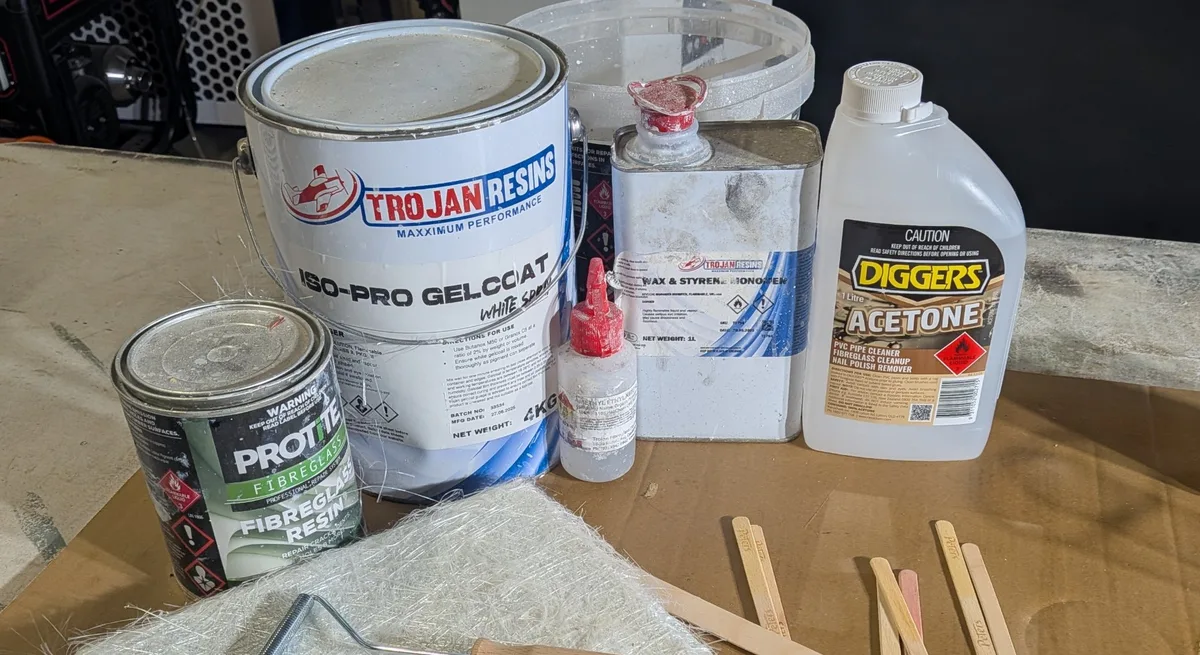
Polyester is the fiberglass resin sold at hardware and marine stores. You harden it with a few drops of MEKP catalyst. Laminating polyester contains no wax and stays tacky between coats on purpose, which surprises people who expect a finished surface. It also gives off styrene. OSHA lists headache, fatigue, dizziness, confusion and drowsiness among the effects of breathing it, and sets the workplace limit at 100 parts per million over an 8-hour shift. For MEKP, NIOSH lists eye and skin irritation, blurred vision and blistering or scarring of the skin, and says to prevent eye contact, so protect your eyes when you measure it. Sealed goggles are a better choice than safety glasses for this. Skip polyester unless you are laying fiberglass.
Polyurethane casting resin is a two-part liquid, much thinner than epoxy and very fast. Smooth-On’s Smooth-Cast 300 gives you 3 minutes to pour and can be demolded in 10. It is also sensitive to moisture, which shows up as bubbles in the cured part. One of the two parts contains isocyanates. OSHA says the main effects of exposure are occupational asthma and other lung problems, along with irritation of the eyes, nose, throat and skin, and the CDC warns that isocyanates can sensitize you, so that a later exposure brings on a severe asthma attack. Smooth-On labels its Crystal Clear 200 urethane “not for home use”. Skip polyurethane unless you are casting parts to paint and can work with a garage door open. If you ever react to it, stop using it.
None of the four stays water-clear in sunlight forever. Smooth-On says outright that “UV stability” in resin products is a fallacy. Why resin turns yellow covers what slows it down.
How deep can you pour, and how long does each take to cure?
These are the makers’ own figures for one named product of each type, checked on October 4, 2026. They are typical, not universal. Your label wins.
| Resin (product) | Depth per layer | Working time | Cure | Heat it tolerates |
|---|---|---|---|---|
| Coating epoxy: ArtResin | About 1/8 inch | About 45 minutes | Dry to the touch at about 24 hours, fully cured at 72 hours | 120°F (50°C) |
| Coating epoxy: TotalBoat TableTop | Up to 1/4 inch per coat | 40 minutes at 70°F | Full use at 3 to 5 days, full cure at 5 to 7 days | 118°F |
| Deep-pour epoxy: TotalBoat Fathom | 2 inches for river pours | 4 to 6 hours | Full cure at 5 to 10 days | Check the label |
| UV resin: Let’s Resin colored UV resin | 2 mm or less | Stays liquid until it is under the lamp | 2 to 3 minutes per side; 4 to 5 minutes for dark colors | Not published |
| Polyester: TotalBoat laminating resin | Not published | Gels in 10 to 20 minutes at 70°F, depending on catalyst | Not published; stays tacky between coats | 155°F |
| Polyurethane: Smooth-On Smooth-Cast 300 | Not published | 3 minutes | Demold at 10 minutes | 120°F |
Where a maker does not publish a figure, I have left it out, not guessed.
Already narrowed it down?
Epoxy or UV? The side-by-side comparison, with what each costs you in time and gear, is in epoxy vs. UV resin for beginners.
Which epoxy: coating, casting or deep-pour? They are different products with different depth limits. Casting resin vs. coating resin sorts them out.
What I’ve used, and what surprised me about epoxy
I worked for a boat-building company, mainly laminating, with some repairs. That meant polyester and polyurethane, in a workshop set up for them. Epoxy is the newer one for me.
Compared with the laminating polyester and fast-cast urethane I was used to, craft coating epoxy is several times thicker and takes days, not minutes or hours, to cure. The data sheets say the same thing: TotalBoat lists its tabletop epoxy at 2,250 cP mixed, against 350 to 450 for its laminating polyester, and Smooth-On lists Smooth-Cast 300 at 80.
For a beginner that is mostly good news. You get far more working time. The cost is the wait, and bubbles that rise slowly through a thick liquid. On my own first epoxy top coat, the surface could still be scratched at 24 hours and was hard at two days.
Four wrong picks to avoid
- Coating epoxy poured an inch deep. A thick mass of epoxy builds up heat as it cures. Use a deep-pour product, or pour in layers.
- UV resin in a deep mold. The light cannot reach the middle, so the inside stays liquid.
- Polyester on a table indoors. It is a styrene job for outdoors or an open garage.
- Expecting any clear resin to stay clear in full sun. None does.
Frequently Asked Questions
What is the difference between epoxy, polyester and polyurethane resin?
Epoxy is a slow, thick, two-part resin that cures clear and suits home craft work. Polyester is the fiberglass resin: cheaper, hardened with MEKP catalyst, and it gives off styrene. Polyurethane casting resin is very thin and cures in minutes, but it contains isocyanates and reacts to moisture.
Is fiberglass resin from the hardware store the same as craft resin?
No. Fiberglass resin is usually polyester. It is made for laminating glass cloth, laminating grades stay tacky between coats, and it gives off styrene. Craft resin is almost always epoxy or UV resin.
Is polyurethane resin better than epoxy for casting?
For opaque parts you will paint, such as miniatures, polyurethane is faster: some grades demold in 10 minutes. For clear pieces made at home, epoxy is the better choice. It gives you far more working time and does not contain isocyanates.
Is epoxy food safe after curing?
Do not assume so. ArtResin says its resin is safe as a food-contact surface when it is measured and mixed according to the label and allowed to fully cure, and that adding colorants can compromise that. Only rely on a food-contact claim that is on your own product’s label or data sheet, and give anything that touches food or drink the full 7 days.
Can I put one type of resin over another?
Never mix two types in the same cup. Layering over a cured piece is different. Epoxy adheres to properly prepared, cured polyester, which is why it is used for fiberglass repairs. The reverse is not recommended: WEST SYSTEM advises against polyester resin for repairing epoxy laminates. I have not found a maker that documents UV resin over cured epoxy, so test that on a scrap piece first.
Sources
- ArtResin FAQ: pour depth, working time, cure times, heat resistance and food-contact wording.
- ArtResin, casting resin vs. epoxy resin: casting resin is thinner and can take up to a week to cure.
- TotalBoat TableTop Epoxy instruction sheet and data sheet: depth per coat, working time, cure, heat deflection and viscosity.
- TotalBoat epoxy selection guide: deep-pour working time, cure and depth.
- TotalBoat polyester laminating resin data sheet: gel time, viscosity, heat distortion and why it stays tacky.
- Smooth-On Smooth-Cast 300: pot life, demold time, viscosity, heat deflection and moisture sensitivity.
- Smooth-On Crystal Clear 200: labeled for industrial use only.
- Smooth-On, UV stability: why no resin is fully stable in sunlight.
- Let’s Resin UV resin product page: layer thickness and cure times.
- Let’s Resin, Know More About UV Resin: lamp wavelength.
- MDedge, Acrylates Named Contact Allergen of the Year: acrylate monomers, the chemistry behind uncured UV resin, are strong irritants and allergens.
- OSHA, Styrene and OSHA Table Z-2: health effects and the 100 ppm limit.
- OSHA, Isocyanates: asthma and irritation.
- CDC/NIOSH, Isocyanates (archived page): sensitization.
- NIOSH Pocket Guide, methyl ethyl ketone peroxide: symptoms and eye protection.
- Epoxyworks, WEST SYSTEM epoxy vs. polyester and Differences Between Polyester and Epoxy: adhesion and repairs.
- Epoxyworks, Controlling Exotherm: why thick pours heat up.
📋 Get the Free Resin Safety & Prep Checklist
A one-page printable checklist covering PPE, ventilation, and workspace setup — so you’re not hunting through this guide mid-pour. Enter your email and we’ll send it straight over.
Free. We only email when there’s something useful, never more than twice a month, and you can unsubscribe anytime. Privacy Policy
Keep Learning on ResinAffairs.com
- Epoxy Resin vs. UV Resin: the two home-friendly types, side by side.
- Casting Resin vs. Coating Resin: which epoxy for which depth.
- Best Resin Molds for Beginners: what to pour your first project into.
Enjoyed this guide? Join the Resin Affairs newsletter for new tutorials, safety tips, and project ideas straight to your inbox.