
Why Is My Resin Sticky? 5 Fixes That Actually Work
Disclosure: This article contains affiliate links. If you purchase through these links, we may earn a small commission at no extra cost to you. We only link to gear we would use ourselves.
As an Amazon Associate I earn from qualifying purchases.
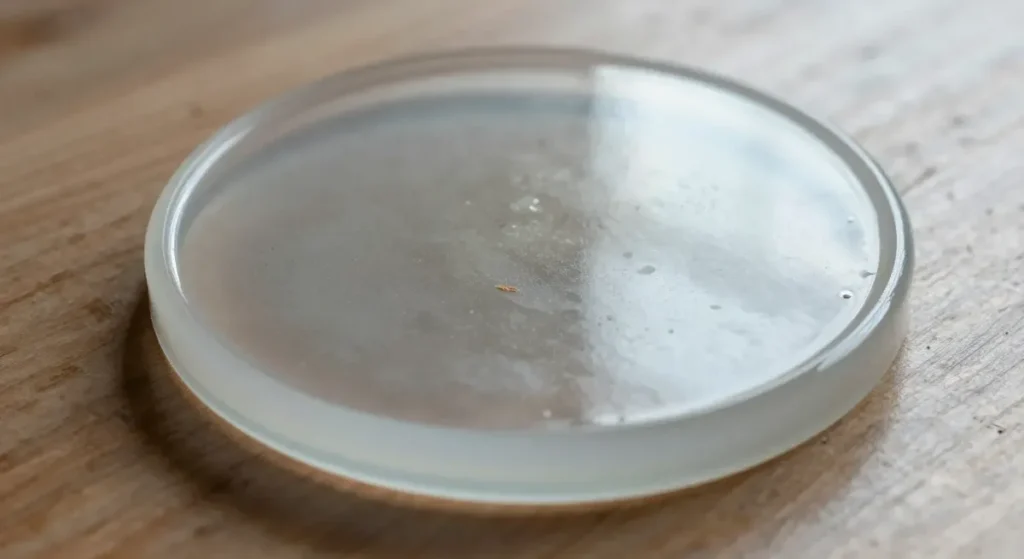
You waited the full 24 hours. You lifted the dust cover expecting glass, and instead your fingertip came away with a faint tug, like touching the sticky side of tape. Or worse, the surface is properly tacky, picking up every speck of dust and the print of anything that touches it. Why is my resin sticky? is the single most common question beginners ask, and the reassuring answer is that in nearly every case, the piece can be saved.
Sticky resin is one of five things that can go wrong with a resin pour. Our full resin troubleshooting guide covers all of them (bubbles, soft spots, cracks and fissures too) and is the place to start if you’re not sure which problem you actually have. This page covers stickiness alone: how to read the cause from the way it looks and feels, how long to wait, and five fixes ranked from least to most invasive.
Quick answer: Resin stays sticky when the chemical reaction between resin and hardener didn’t finish. The usual causes are an off ratio, under-mixing, or a cold or humid room, but old, moisture-exposed hardener and a contaminated mold surface can do it too. If the surface is only slightly tacky, warmth and time (up to 48 hours) may finish the cure. If it’s still sticky after that, sand it back and recoat with a fresh, correctly measured batch.
First, Is It Sticky or Did It Not Cure at All?
This matters because the fixes are different. Sticky resin is mostly hard: the piece holds its shape, you can pick it up, and the problem is a tacky film on the surface or a few soft, gummy patches. Resin that didn’t cure is still liquid, gel-like, or soft all the way through after 48 hours, and it can’t be rescued with heat or patience. If that’s what you’re looking at, you need our guide to fixing resin that didn’t cure instead. Everything below assumes the piece is mostly solid.
Why Is My Resin Sticky? The 5 Causes
Epoxy cures through a chemical reaction between Part A (resin) and Part B (hardener). Stickiness means some of that reaction didn’t happen, and there are only so many ways that can go wrong. Here are all five, starting with the three you’ll find in every guide and finishing with two that hardly anyone mentions.
Cause 1: The ratio was off
Every unreacted molecule of resin or hardener stays liquid forever. Too much resin leaves the surface tacky; too much hardener leaves it soft, sometimes with an oily film. The frustrating part is how little it takes: a 10% error can be enough to stop a full cure.
How to tell: a ratio problem is uniform. The whole surface is equally tacky, with no hard areas and no soft areas, because the same wrong mix went everywhere.
The 1:1 vs. 2:1 wrinkle: not all ratios are equally forgiving. A 1:1 resin has some tolerance because a small measuring slip changes the proportion only slightly. A 2:1 or 3:1 system is far less forgiving, because the same small slip on the hardener side is a much bigger percentage error. And a ratio that’s given by weight can’t be measured in volume cups: resin and hardener have different densities, so equal volumes are not equal weights. Our mixing guide walks through this in detail.
Cause 2: It wasn’t mixed enough
Three to five minutes of slow, scraping mixing is the minimum, and most beginners stop at one. Resin clinging to the sides and bottom of the cup never meets the hardener, and if it makes it into the mold, it stays liquid there.
How to tell: under-mixing is patchy. Most of the piece cures hard while one area, often the last bit poured or the edges, stays sticky or gummy. Sticky in one spot almost always means mixing, not ratio.
Cause 3: The room was too cold or too humid
Most craft epoxies want 70–80°F (21–27°C) for the whole cure, not just while you’re mixing. Below about 65°F (18°C), the reaction slows to a crawl and can stall before it finishes. High humidity (trouble starts above roughly 70%, so aim for 60% or lower) can leave a cloudy, tacky film on the surface even when the resin underneath is fine. If that film feels waxy or greasy rather than sticky, it’s likely amine blush, a water-soluble byproduct of curing in damp air. Scrub it off with warm soapy water and a scouring pad, then dry the piece before you sand, or the film will clog the sandpaper.
How to tell: temperature stickiness is uniform like a ratio problem, but it often comes with other clues: the piece is bendy rather than hard, or there’s a milky haze on the surface, or you know the room dropped cold overnight. This is also the one cause where waiting can still work, because the reaction hasn’t failed, it’s just slow.
Cause 4: Old or badly stored hardener
This one gets missed constantly. Hardener (Part B) is the fussier of the two bottles. Left with the cap loose, stored somewhere humid, or simply kept past its shelf life (typically 6–12 months after opening depending on the brand, so check your label), it absorbs moisture from the air and slowly degrades. Degraded hardener reacts less completely, so even a perfectly measured, perfectly mixed batch cures soft or sticky.
How to tell: the hardener has thickened or turned cloudy (a yellow or amber tint alone is usually normal oxidation and still cures), or you’ve noticed crystals or a crust around the cap. If your technique hasn’t changed but your last two pours have both come out tacky, suspect the bottle before you suspect yourself.
Cause 5: The surface it was poured onto
Resin can be mixed perfectly and still cure tacky at the interface, the layer touching the mold or substrate. Water is the usual culprit: a silicone mold that was washed and not fully dried, a wooden blank that’s still damp, or condensation on a cold mold brought in from a garage. Oily residues do it too: soap film left in a mold, excess mold-release spray, fingerprints on a glossy surface, or the natural oils in some woods and fresh flowers. In each case the resin body cures but the face that touched the contamination stays tacky or cloudy, and often demolds with a dull, streaky finish.
How to tell: the stickiness is on the mold side of the piece (the side that faced the silicone), not the open top, or it follows the exact outline of an embed. The top surface is fine.
A Quick Diagnosis Table
| What you see | Most likely cause | Best fix to try first |
|---|---|---|
| Evenly tacky all over the top surface, piece is hard underneath | Ratio slightly off, or cold room | Warm it and wait (Fix 1), then heat-gun (Fix 2) |
| Evenly soft, bendy, or gummy all over | Ratio well off, or very cold cure | If it was cold, warm it first (Fix 1). Otherwise scrape and restart (Fix 4) or discard (Fix 5) |
| Hard piece with one sticky patch or sticky edges | Under-mixing, or scraped the cup while pouring | Sand and recoat (Fix 3) |
| Sticky only on the mold side, top is fine | Damp or contaminated mold or surface | Wipe with isopropyl alcohol, sand lightly, recoat (Fix 3) |
| Milky or cloudy tacky film on top | Humidity, or cold resin mixed too fast | Warm it and wait (Fix 1). Wash a waxy film off with warm soapy water, then sand and recoat (Fix 3) |
| Two batches in a row have cured sticky with the same technique | Old or moisture-exposed hardener | Replace the hardener, then recoat (Fix 3) |
🧰 Recommended Kit for This Project
- Digital Scale for Resin (Precise to 0.1g) — the single best fix for ratio-caused stickiness if your resin mixes by weight
- Heat Mat for Resin Curing — holds a steady cure temperature in a cold room, which fixes Cause 3 before it starts
- LET’S RESIN Heat Gun for Resin Crafts — for Fix 2 below, and for bubble removal on the recoat
- LET’S RESIN Epoxy Resin Kit with Sphere & Pyramid Molds — fresh, correctly labeled resin and hardener to rule out an old bottle as the cause
How Long Is Too Long? 24 vs. 48 vs. 72 Hours
The number you’ll see everywhere is 48 hours: if resin is still sticky after two days, it isn’t going to finish on its own. That’s a good rule of thumb, but it hides a lot of variation between products, so here’s a more honest timeline.
- At 24 hours: a slight tackiness is normal for many standard-cure resins, especially in a cool room. Most products list 24 hours as “tack-free,” not “fully cured,” and full cure can take 3–7 days. If the surface is only faintly sticky, don’t do anything yet. Warm the room and give it another day.
- At 48 hours: a standard resin that’s still tacky at this point has almost certainly stalled. Fast-cure resins (products advertising 8–12 hour cures) should have been hard a day ago, so for those, 48 hours of stickiness is a clear signal that something in the chemistry was wrong. Time to move to a fix.
- At 72 hours and beyond: if it’s still sticky, it’s staying sticky. The one exception is a deep-pour or slow-cure casting resin, some of which are genuinely rated for 72-hour or longer cures at cool temperatures. Check your label’s full-cure time before you give up on it.
- Any time it’s actually liquid: stop waiting. Liquid or gel-like resin at 48 hours is a non-cure, not stickiness, and belongs in our didn’t-cure guide.
5 Fixes for Sticky Resin, Ranked from Easiest to Last Resort
Work down this list in order. Each fix is a little more work than the one before it, and each is the right answer for a different severity of stickiness. Stop at the first one that works.
Fix 1: Warm it and wait
For: faint tackiness at 24 hours, a cold room, or a slow-cure product. Move the piece somewhere that stays at 75–80°F (24–27°C), on a seedling heat mat or in the warmest room in the house, out of drafts, and give it another 24 hours under its dust cover. If the ratio was close and the reaction simply slowed down, this finishes it. It costs nothing and risks nothing, so it’s always the first thing to try.
Fix 2: Heat-gun the surface
For: a surface that’s still lightly tacky after warming. Set a heat gun to low, hold it 6–8 inches from the surface, and keep it moving in slow sweeps for a minute or two, then let the piece rest warm. The gentle heat can push a nearly-complete reaction over the line. What it can’t do is fix a piece that’s soft underneath, and holding the heat in one spot will scorch, wrinkle, or yellow the resin, so if two passes haven’t changed anything, move on.
Fix 3: Sand it back and recoat
For: a hard piece with a sticky top surface, sticky patches, a sticky mold side, or a cloudy film. This is the fix that actually works for most sticky resin, and it’s easier than it sounds:
- Wipe the sticky surface with a paper towel dampened with 91%+ isopropyl alcohol to lift as much uncured resin as you can. Change towels often.
- Sand the whole surface with 120–220 grit sandpaper until it’s uniformly dull. You’re removing the sticky layer and giving the new resin something to grip, so don’t worry about scratches; the new coat will fill them. Wear gloves and an N95 mask while you sand, because dust from under-cured resin irritates skin and lungs (our guide to resin sanding dust covers the setup).
- Wipe again with alcohol and let it dry completely. Any dust or alcohol left behind will show through.
- Mix a fresh, small batch of resin, measured carefully and mixed with the two-cup method, and pour a thin flood coat over the top. Pop bubbles, cover, and cure at 70–80°F.
Don’t pour new resin over sticky resin without sanding first. The new layer won’t bond to an uncured surface, and you’ll end up with two problems instead of one.
Fix 4: Scrape it off and start the pour again
For: a piece that’s gummy or soft to a real depth, not just on the surface. If a gloved fingertip sinks in, there’s too much uncured resin to sand through. Scrape out everything soft with a plastic scraper or an old spoon (for a mold) or a putty knife (for a coated surface), wipe the cavity or surface thoroughly with alcohol, let it dry, and then pour fresh. If it’s a coaster or pendant, this often means demolding what you can, cleaning the mold, and pouring a new piece. Silicone molds survive this fine; wipe them with alcohol and let them air-dry fully before reusing.
Fix 5: Discard it and start with fresh resin
For: a piece that’s soft all the way through, a second failed attempt, or any time you suspect the hardener itself. Sometimes the cheapest fix is a new pour. Let the uncured resin cure as far as it will (leave it in a silicone cup or on plastic sheeting for a few days), then dispose of it as solid household waste. Never pour liquid resin down a drain. If you suspect the hardener, replace the kit rather than fighting the same bottle again: a new, in-date kit with a fresh, correctly measured ratio is the fastest way to prove whether the problem was the chemistry or the technique.
📋 Get the Free Resin Safety & Prep Checklist
A one-page printable checklist covering PPE, ventilation, and workspace setup — so you’re not hunting through this guide mid-pour. Enter your email and we’ll send it straight over.
Free. We only email when there’s something useful, never more than twice a month, and you can unsubscribe anytime. Privacy Policy
How to Stop It Happening Next Time
- Measure by the method on your label (volume or weight), in marked cups or on a scale, every time. Never eyeball it, and never add extra hardener “to be safe.”
- Mix for the full 3–5 minutes, scraping the sides and bottom, then transfer to a second cup and mix again. Don’t scrape the second cup when you pour. (Full walkthrough in how to mix epoxy resin, and the pour itself in our step-by-step pouring guide.)
- Keep the room, the bottles, and the mold at 70–80°F for the whole cure. Warm cold bottles in a bowl of warm water before mixing.
- Cap the hardener tightly the moment you’ve measured it, store it somewhere cool and dry, and write the date you opened it on the bottle.
- Make sure molds are bone dry and free of soap or release residue before you pour. If in doubt, wipe with alcohol and let it evaporate fully.
Frequently Asked Questions
Why is my resin still sticky after 24 hours?
Slight tackiness at 24 hours is normal for many standard-cure resins, especially in a room below 70°F, because 24 hours is usually the tack-free time, not the full-cure time. Warm the room to 75–80°F and give it another day. If it’s still noticeably sticky at 48 hours, the cause is most likely an incorrect ratio, under-mixing, a cold or humid cure, old hardener, or a damp or contaminated mold, and the piece will need to be sanded and recoated.
Will sticky resin eventually harden?
Sometimes. If the ratio was close and the resin was simply cold, warming it to 75–80°F for another 24 hours can finish the cure. If it’s still sticky after 48 hours (or 72 hours for a slow-cure casting resin), it won’t harden on its own: the unreacted resin has nothing left to react with. At that point the fix is to sand the sticky layer off and pour a fresh, correctly measured coat over it.
Can I fix sticky resin without sanding?
Only if the stickiness is very mild. Warming the piece and waiting another day, or a careful low-heat pass with a heat gun, can finish a cure that stalled from cold. Anything more than faint tackiness needs sanding, because new resin won’t bond to an uncured surface. Sanding at 120–220 grit takes only a few minutes on a small piece and the recoat hides the scratches completely.
Is sticky resin safe to touch?
Treat it as uncured resin, because that’s what it is. Uncured epoxy is a skin sensitizer, so wear nitrile gloves whenever you handle a sticky piece, and don’t let it sit anywhere children or pets can touch it. Once it’s been sanded and recoated with a batch that cures fully, it’s as safe as any other cured resin piece.
How do I know if my resin ratio was wrong?
A ratio problem is uniform: the whole surface is equally tacky or soft, with no hard areas and no isolated patches, because the same wrong mix went everywhere. Under-mixing, by contrast, leaves a mostly hard piece with a few sticky spots. If you measured a 2:1 or 3:1 resin in volume cups when the label says to mix by weight, or you eyeballed either part, assume the ratio was the cause.
Can old hardener make resin sticky?
Yes. Hardener absorbs moisture from the air once opened, and over time it darkens, thickens, and reacts less completely, so even a perfectly measured, well-mixed batch can cure soft or tacky. If your hardener has thickened or turned cloudy, has crystals around the cap, or is more than about a year past opening, replace it before you pour again.
Sources
- OSHA, Hazard Communication: the label, Safety Data Sheet and technical data sheet are where your exact ratio, mix method and cure times come from, so check them before blaming the pour.
- Epoxyworks (WEST SYSTEM), Controlling Exotherm: epoxy speeds up or slows down sharply with temperature (every 18°F roughly halves the working time), which is why a cold room can stall a cure.
- Epoxyworks (WEST SYSTEM), What Is Amine Blush?: why a cool, humid cure can leave a waxy or greasy film, and why you wash it off with water before sanding.
- WEST SYSTEM, Epoxy Shelf Life & Storage: how moisture gets into opened containers, and that darker color alone doesn’t mean a hardener has gone bad.
- WEST SYSTEM, Health Effects From Overexposure to Epoxy: uncured epoxy is a skin sensitizer, and you can become sensitized after many exposures or just one, so any sticky piece gets handled with gloves.
- NIOSH (CDC), Epoxies and resins: wear the right gloves, increase ventilation, and wash skin as soon as possible after contact.
- WEST SYSTEM, Preventing Overexposure: gloves, ventilation and dust control while you sand and recoat.
The Short Version
Sticky resin is unfinished chemistry, not a ruined project. Work out which of the five causes you have from the pattern of the stickiness, try warmth first, and if that doesn’t finish it by 48 hours, sand it back and recoat. Almost every sticky piece ends up glossy in the end. And if stickiness is only one of several things that went wrong with the pour, our full troubleshooting guide has the rest.
Keep Learning on ResinAffairs.com
Stickiness is one problem of several. Here’s where to go next:
- 🛠️ Common Resin Problems and How to Fix Them → — the full troubleshooting guide: bubbles, soft spots, cracks and fissures too.
- 🧊 How to Fix Resin That Didn’t Cure → — for resin that’s still liquid or gel-like after 48 hours, not just tacky.
- 🥄 How to Mix Epoxy Resin → — ratios, the two-cup method and cure times, the root-cause fix for most sticky resin.
- 🫗 How to Pour Epoxy Resin → — pour height, speed and the first 10 minutes, so the next pour cures clean.
- 🧤 Resin Safety Hub → — handling tacky, uncured resin safely starts with the right gloves and ventilation; the full safety hub has the basics.
- How long does resin take to cure → — the normal timeline, so you can tell a stalled cure from a slow one.
Enjoyed this guide? Join the Resin Affairs newsletter for new tutorials, safety tips, and project ideas straight to your inbox.