
Last-Minute Resin Gifts You Can Still Finish Before Christmas
Resin Affairs is reader-supported. If you buy through links on this page, we may earn a small commission at no extra cost to you. We only link to gear we would use ourselves — prices and availability change, so check the current listing. Always follow your resin product’s label and Safety Data Sheet.
📍 Which guide do you need? This page is built for tight deadlines — a handful of days or less. If you’ve got a few weeks to spare, our full Resin Gift Ideas for Beginners guide has more project options and a plan-ahead calendar.
As an Amazon Associate I earn from qualifying purchases.
It’s the middle of December, you want to give something handmade, and you’ve just found out that epoxy resin takes days to cure, not hours. The good news: last-minute resin gifts are still very doable. The question is which project, and that depends entirely on how many days you have left, so this page is sorted by days left, not by project. Count to the day you wrap it, not to Christmas morning.
If you are reading this before 10 December, the timeline in our Resin Gift Ideas for Christmas guide is the better plan. If it is later than that, you are in the right place. One rule holds for everything below: a resin gift is ready when the label’s full-cure time has passed and it is hard with no tack (smell alone is not a reliable test) — not when it looks done.
Quick answer: With a week or more, small epoxy projects like coasters, ornaments and keychains will cure in time. With 3–6 days, pour thin pieces only, keep the room warm and skip second coats. With 48 hours or less, switch to UV resin, which cures in minutes under a lamp. With no time at all, gift a make-it-together kit. Never wrap resin that is still tacky.
First, Be Honest About the Clock: Real Resin Cure Times
Here are the real numbers, in plain words.
Most craft and coating epoxy is touch-dry in 12–24 hours, firm enough to demold at 24–48 hours, and properly hard at about 72 hours. Deep-pour and casting resins need up to 7 days, which puts them out of the running. UV resin is the exception: it cures in minutes under a 36W or stronger lamp, though some brands stay faintly tacky for a few hours to a day afterward.
Two phrases matter here. “Wrappable” means the piece is hard, has no tack and has no smell; for epoxy, that is about 72 hours after the pour. “Ready for daily use” is different: coasters and small dishes want a full week before anyone puts a hot mug on them. Wrap at 72 hours and tell the recipient to wait a week before using it.
The times on this page come from resin manufacturers’ own cure schedules and our own beginner testing, and your label overrides all of them. The label always wins. For the stage-by-stage detail, see how long resin takes to cure.
Three things decide whether your piece is ready on time:
- A warm room is the one speed-up that works. Aim for 75–80°F. Below about 65°F, resin slows to a crawl, and that is exactly why December garage pours fail: the piece that should be hard on day three is still soft on day five. Bring it inside — to a warm room you do not sleep in, with some air moving, the piece covered against dust, and kids and pets kept out, as your label and Safety Data Sheet describe.
- Hair dryers, ovens and radiators do not help. They usually cause warping or soft spots, as our hair dryer versus heat gun post explains.
- Extra hardener makes things worse, not faster. The ratio is chemistry, not a dial; our mixing guide covers why.
| Days left | What’s realistic | What to skip |
|---|---|---|
| 7+ days | Small epoxy pieces: one pour, one finishing day | Trays, tumblers, deep pours |
| 3–6 days | Thin epoxy (1/4 inch or less), warm room, no second coat; or UV resin | Deep molds, anything needing a flood coat |
| 48 hours | UV resin (epoxy only if your label says 24-hour full cure, with a backup) | Any epoxy piece you cannot afford to lose |
| 24 hours or tonight | UV resin if you own a lamp; otherwise a make-it-together kit or a cured spare | Pouring epoxy at all |
🧰 Recommended Kit for Last-Minute Gifts
- LET’S RESIN UV Resin with Light, 200g Starter Kit — resin and lamp in one box; the option for 48 hours or less.
- Let’s Resin 16oz Epoxy Resin Kit & Molds Complete Set — resin, molds, pigment and dried flowers in one order, for the 3-day-plus projects.
- LET’S RESIN Large Alphabet Mold with Hole, 30 Jump Rings & 30 Key Rings — initials and keychains from one mold, hardware included.
- Digital Gram Scale — a mismeasured ratio is how a last-minute pour turns into nothing to give; weighing both parts removes the guesswork.
- Caffox Bookmark Mold Kit, 10 Molds + 100 Tassels — the quickest epoxy gift to set up: thin pour, tassel on, done.
7+ Days Left: Almost Any Small Gift Is Still On
A week is enough. Coasters (a set of four), Christmas ornaments, keychains, bookmarks, trinket dishes and pendants all cure comfortably in this window, and each has a full tutorial on the site; they are all linked in the shortlist further down.
Treat the week as one project, not six. Pour everything in a single mixing session on day 1; a single 4–6 oz mix fills a coaster mold and a keychain sheet. Leave all of it untouched for 3 days. Demold and finish on day 4 or 5: sand any sharp edges, add key rings and tassels, wipe everything down. That leaves 2 days of buffer for the piece that came out with a dent.
Do not start anything new after day 4. A pour on day 5 is a pour that is still soft on Christmas Eve.
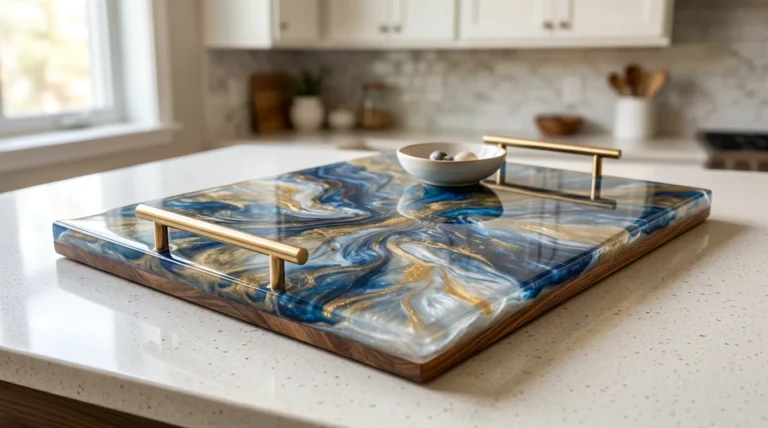
Even with a full week, some projects are out. Serving trays need layers, a flood coat and a week to reach full hardness, as our serving tray tutorial explains. Tumblers need several coats on a turner. Anything deep-pour needs up to 7 days just to cure, before any finishing at all. Save those for a January birthday.
3 to 6 Days Left: Thin Pours, Warm Room, No Second Coats
This is the tight-but-doable window, and thin is the whole strategy. Keychains, ornaments, bookmarks, small charms and pendants, and a shallow trinket dish all still work. Coasters work too, if you have 4 or more days and a shallow mold.
The rules:
- Use a 1:1 craft epoxy, not deep-pour. Deep-pour resin is built to cure slowly, and slow is the one thing you cannot afford.
- Pour thin, 1/4 inch or less. Thin layers cure faster and more evenly.
- Warm the bottles in a warm-water bath before measuring, lids on, and dry the bottles before you open them. Warm resin mixes cleaner and cures faster; water in the mix means cloudy, sticky pieces.
- Mix for a full 3 minutes anyway. Rushing the mix is how last-minute pieces end up permanently sticky. Our sticky resin guide lists the causes, and under-mixing is at the top.
- Keep the piece in the warmest room you can ventilate, covered against dust, and leave it alone.
- Demold at 48 hours, then give it one more day before wrapping.
Skip the doming or flood coat entirely; a second coat adds a full cure cycle you do not have. Instead, wet-sand the edges (400 grit, then 1000) and accept a satin edge, or give it a quick hand polish.
Plenty of beginners’ first coasters get gifted with a short note saying “let these sit a week before hot drinks.” That is normal. The recipient gets a gift on Christmas morning and a working coaster by New Year. Check the heat rating on your resin’s label, too: a warm mug is usually fine once the piece is fully cured, but very hot ones can leave a mark.
48 Hours or Less: Switch to UV Resin
UV resin is the fastest option here. It cures in 1–3 minutes per thin layer under a lamp. Keep each layer to about 1/16 inch (2 mm) or less and build up in passes, curing between each one. Small pieces only: jewelry, charms, keychains, initials, thin ornaments, phone grips and small bookmarks. Thick UV pours cure unevenly and can yellow, so this is not the route to a coaster.
A strong lamp matters, 36W or more; a weak one is the usual reason UV pieces stay tacky. Keep your gloves on, and do not look into the lamp or put your hands under it while it runs. After the final cure, check for surface tack with a gloved fingertip. If it is faintly sticky, give it another minute under the lamp, or wipe it with 99% isopropyl alcohol on a lint-free cloth — gloves on, in a ventilated spot, well away from any flame, since the alcohol is flammable. The residue on the cloth is uncured resin, so bin the cloth.
If you have never used UV resin, our UV resin beginner guide covers the lamp, layering and safety in one read, and epoxy versus UV resin explains when each is the right choice. Keychains and name and initial pieces both translate to UV easily. No lamp? Many craft stores carry UV resin and small lamps; see the supplies section below.
Can you do epoxy in 48 hours? Only if your resin’s label states a full cure of 24 hours or less, only for the thinnest pieces, and only in a truly warm room. Even then, have a plan B: if it is still soft at hour 40, you have nothing to give, so have a UV piece or the kit idea below ready before you pour. For a standard 72-hour epoxy, 48 hours is not enough. Do not pour it.
Tonight: Gifts That Need No Curing Time at All
If you own a UV lamp, make a UV resin gift tonight. A keychain or a pair of earrings is done in minutes, and it really is done: no waiting, no tack check in the morning.
If you do not own a lamp, the best option is the make-it-together kit. Put a small starter kit and a mold set in a box, and add a card promising an afternoon making it together. For a teen or a crafty friend this is a better gift than a finished coaster, with an adult doing the mixing and the age guidance on the kit checked first. It also turns a last-minute scramble into something shared.
Then there is the drawer gift. Every resin crafter has cured test pieces and spares tucked away. Pick the best one, add a tassel or a key ring, and it is a finished gift with a story attached.
And if none of those fit, the promise card: a photo of the mold and the plan, with the finished piece to follow in January. Handmade gifts are allowed to arrive late.
The Last-Minute Shortlist: Quick Resin Gifts by Cure Time
Everything above in one place, so you can pick a project and go. Each gift name links to its full tutorial.
| Gift | Resin | Ready to wrap |
|---|---|---|
| Keychains and charms | UV | Same day |
| Initial or letter pendants | UV (or epoxy) | Same day (epoxy: 3 days) |
| Pendants and earrings | UV | Same day |
| Christmas ornaments | Epoxy or UV | 3 days (UV: same day) |
| Bookmarks | Thin epoxy | 3 days |
| Trinket dish | Epoxy | 3 days |
| Coasters (set of 4) | Epoxy | 4 days, shallow mold; a week before hot mugs |
Every gift here is 30–45 minutes of hands-on time; the rest is curing. “Ready to wrap” assumes the piece sits in a 70–80°F room the whole time; a cold room adds days.
Getting Supplies in Time
Check what you already own first. Gloves, a mat to work on, mixing cups, stir sticks, a heat gun or lighter for bubbles and a few molds cover most of the list. What most people are missing is the resin itself, or a UV lamp.
For a last-minute project, buy small. A small 1:1 craft epoxy kit or a UV resin starter kit with a lamp is the right purchase; a gallon of deep-pour is not. A mold set with several small cavities beats one big mold, because one pour gives you several gifts and a spare if one fails.
If you cannot wait for delivery, many craft stores carry UV resin and small lamps; check stock online or call before driving over. If you are ordering online with a few days to spare, delivery speed matters more than anything else now. Amazon’s free Prime trial (referral link), if you are eligible, unlocks faster delivery on eligible items; trust the delivery date shown at checkout, not the one on the listing.
If the gift has to be mailed, the carrier’s holiday cut-off eats days too; the timeline section of our Christmas resin gift guide covers working backwards from it.
Last-Minute Mistakes That Ruin the Gift
- Wrapping too early. Tissue paper welded to a tacky coaster, or a thumbprint set into the surface for good, is the classic last-minute failure. Wait until the label’s full-cure time has passed and it is hard with no tack.
- Trying to speed epoxy with heat or extra hardener. Heat gives you warping and soft spots; extra hardener gives you a piece that never cures. A warm room is the only shortcut.
- One thick pour to save a step. A single deep pour of craft epoxy can overheat as it cures, which cracks, bubbles and yellows it. Pour in layers of about 1/8 inch. Thin layers cure properly; our pouring guide for beginners shows how.
- Rushing the 3-minute mix. Under-mixed resin stays sticky forever. Why resin gets sticky diagnoses it and how to fix resin that did not cure tells you what can be saved.
- Pouring in a cold garage or spare room. The single most common reason a Christmas piece is not ready. Bring it into a warm, ventilated room.
- Forgetting a finishing day. Sharp edges and rough mold flash on a gift are avoidable. Budget a day for sanding and a final wipe.
- Skipping gloves and ventilation because it is a small pour. A closed-up winter house is the worst place for fumes, and a small pour is still uncured resin near your skin. Our PPE guide for resin beginners and the resin safety hub cover the short version.
When and How to Wrap a Resin Gift
Wait until the piece is wrappable — about 72 hours for epoxy in a warm room, and a passed tack check for UV — before anything touches the surface. Wrap in tissue paper, never plastic wrap or a sealed plastic bag; both trap the last of the fumes and can mark a surface that is not quite done.
Add a one-line care card: “wait a week before hot drinks, hand-wash only, keep out of direct sun.” It stops a coaster from being ruined on day one, and it quietly explains why the piece is not ready for use yet. For wrapping and packaging ideas by project type, see our full guide to resin gift wrapping.
Frequently Asked Questions
Can I make resin gifts in a week?
Yes. A week is enough for any small epoxy gift: coasters, ornaments, keychains, bookmarks, trinket dishes and pendants. Pour everything on day 1, leave it untouched for 3 days, demold and finish on day 4 or 5, and keep 2 days in reserve. Skip serving trays, tumblers and deep pours, which need more than a week.
How long does resin need to cure before I can wrap it as a gift?
About 72 hours for craft epoxy in a warm room, which is when it is hard with no tack. (Low-odor resins barely smell from the start, so smell isn’t a reliable test.) UV resin can be wrapped the same day once it passes a tack check. Coasters and small dishes are wrappable at 72 hours but want a full week before hot mugs, so add a care note.
What is the fastest-curing resin for last-minute gifts?
UV resin. It cures in 1–3 minutes per thin layer under a 36W or stronger lamp, so a keychain, pendant or pair of earrings can be finished and wrapped the same evening. It only suits small, thin pieces, though: keep layers to about 1/16 inch (2 mm), because thick UV pours cure unevenly and can yellow.
Can you speed up epoxy resin curing for a last-minute gift?
Only by keeping the room warm, around 75–80°F, which is the one speed-up that works. Hair dryers, ovens and radiators cause warping, cracks and soft spots, and extra hardener stops the resin curing at all. If a warm room is not fast enough for your deadline, switch to UV resin rather than forcing epoxy.
Is 2 days enough time to make a resin gift?
Yes, if you use UV resin, which cures in minutes under a lamp and can be wrapped the same day. Standard 72-hour epoxy is not ready in 48 hours; only a resin whose label states a 24-hour full cure stands a chance, and only for thin pieces in a warm room. Have a backup ready.
What resin gifts can I make in one day?
With a UV lamp, keychains, charms, initial pendants, earrings, thin ornaments and small bookmarks can all be made and wrapped in one day. Without a lamp, no resin pour will be ready in 24 hours; give a make-it-together starter kit, a cured spare from your drawer, or a card promising the finished piece in January.
Keep Learning on ResinAffairs.com
Whichever tier you landed in, these guides cover the next step.
- Resin Gift Ideas for Christmas: Easy DIY Gifts Anyone Will Love — the plan-ahead timeline and six full tutorials
- UV Resin for Beginners: The Complete Starter Guide — lamp, layering and safety for the same-day gifts
- How Long Does Resin Take to Cure? Epoxy, UV & Deep Pour — the stage-by-stage detail behind every number on this page
- How to Make Resin Keychains: A Beginner’s Guide — the fastest epoxy or UV gift to batch
- DIY Resin Christmas Ornaments: A Beginner’s Step-by-Step Guide — a dozen from one mold sheet
- How to Make Epoxy Resin Coasters (Without Ruining Your First Batch) — for the week-or-more tier
- Resin Gift Wrapping & Pairing Ideas
Enjoyed this guide? Join the Resin Affairs newsletter for new tutorials, safety tips, and project ideas straight to your inbox.